


What is a New Entrant Safety Audit?
A New Entrant Safety Audit is an FMCSA review of a new motor carrier’s records and safety management controls.
Once a new motor carrier begins operations, FMCSA will conduct an audit within the first 12 months. It doesn’t just cover vehicles.
The audit reviews your records to determine if your company has basic safety controls in place. You may have time to correct problems, but failure to pass the New Entrant Safety Audit can put you out of service, so taking it seriously by maintaining clean, easily accessible records is critical. “I know it’s in here somewhere” isn’t a great look at an audit.
What Happens at a New Entrant Safety Audit?
FMCSA will review three categories of your business: driver, vehicle, and company-level safety. They check your records to verify your HOS and safety practices. They will notify you of an audit by phone or regular mail.
Your audit may be conducted onsite or electronically. If it’s scheduled for an electronic review, you’ll be asked to submit your records. If you don’t have everything in a computer file, ask the auditor how they want the records.
1. Driver-Related Records
The auditor already knows someone is driving your truck. You must provide records that prove the driver is qualified to handle your rig. As a trucking business owner – even as a sole proprietor or as an LLC – you will be expected to maintain records about your driver (even when it’s you.)
| Record Type | What the Auditor Requires |
|---|---|
| CDL and endorsements | Copies of every driver’s commercial driver’s license and required endorsements. |
| Medical certificates (DOT Medical Card) | Proof that all drivers meet FMCSA medical qualifications, including the medical examiner’s National Registry number. |
| Drivers List | The list of drivers employed in the last 12 months, including hire and termination dates. |
| Driver Qualification File | Completed driver employment application, prior employer checks, Motor Vehicle Record from state/MVR service, safety performance history, road test or equivalent. |
| Records of Duty (RODs) and supporting documentation | ELD logs, edits, annotations, supporting documents and exemptions if used. |
Even if you’re an owner-operator, you are expected to maintain your own records with your business records.
2. Vehicle-Related Records
Spiffing up your vehicle is always a nice touch – for the person driving it. The auditor won’t be impressed – they’re looking to see what’s hiding in the maintenance files, not what’s under the passenger seat. (But throw those old coffee cups away.)
| Record Type | What the Auditor Requires |
|---|---|
| Vehicle List | Current list of vehicless and trailers, with unit number, VIN, plate number and state registration. |
| Maintenance files | Vehicle ID sheet, PM schedule, all repairs, and inspections. |
| Roadside inspection reports | 12-month retention and proof of corrective action. |
| DVIRs | Only required if defects or deficiencies are found. |
| Annual inspections | Proof of annual DOT inspection and inspector’s qualifications. |
| Hazardous Materials (HM) shipping papers | If applicable, shipping papers for each type of HM transported. |
3. Company-Level Safety Records
The auditor may request some records to be sent ahead of the audit. If they’re only stored in your head, that might be difficult to upload. Same goes with the shoebox in the basement. The auditor wants to see how you manage safety compliance issues.
| Record Type | What the Auditor Requires |
|---|---|
| Insurance documentation | Proof of liability coverage to the minimum public liability requirement and the MCS-90 endorsement, when applicable. |
| Safety policies | HOS, drug/alcohol, maintenance, driver hiring, and training. |
| Training records | Required training records, such as hazardous materials training, when applicable. |
| Accident register | Register of FMCSA-reportable crashes, retained for three years after each crash, with required supporting records. |
| Drug and alcohol program/test results | Pre-employment test results, post-accident tests, random testing program records, MIS reports, and refusal documentation. FMCSA Clearinghouse queries pre-employment and annually. |
HOS supporting documents – BOLs, fuel receipts, toll records, and other trip documents can be requested to confirm your driver logs make sense.
How to Organize Your Records
The key to organizing your records is consistency and immediate handling. A pile on top of a file cabinet is not organization, nor is “I know it’s on my computer somewhere.”
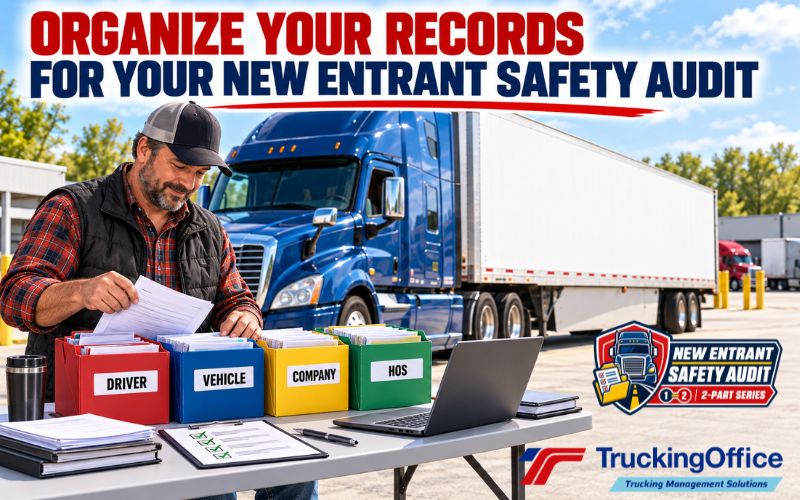
- Create separate folders for driver information, vehicle data, and your company. A list of the required documents would be useful – you can use it as a checklist.
- Use consistent naming protocols. “Red Flash” is a great name for a truck, not so much for a computer file unless you use it with some additional description. “Red Flash New Brakes Feb 3 2027” is a good protocol: the vehicle ID, the repair, and the date. Whatever you decide to use, you’ll be glad when you can find what you’re looking for quickly because you took the time to name it well.
- Review your records regularly. Annual or inconsistent deadlines can slip by easily. When you update your Motor Carrier Identification Report (MCS-150) with new address or contact information, save it in your records. Medical card expirations and annual truck inspections sneak up on us. If you drove for another company before opening your own trucking business, the medical card can come due at any time.
- Back up your records. Cloud storage, extra thumb drives, and burying your records in a treasure chest in the backyard with an X on the ground can work. Just don’t lose the map.
- Keep your audit records secure. Sensitive driver and drug-testing records need to have restricted access.
New Trucking Authority Needs New Habits
Establishing efficient habits as an owner-operator will save you a lot of grief down the road. By keeping your records clean and organized, you’ll avoid the stress that an audit can cause. Those same records aren’t only important for the New Entrant Audit – you’ll need them again in the future of your company. TruckingOffice TMS can keep your records together and accessible without scrambling because of an unexpected DOT audit.
FAQs
What records may FMCSA request during a New Entrant Safety Audit?
FMCSA may request driver qualification files, HOS records, drug and alcohol program records, vehicle maintenance and inspection records, insurance documents, and an accident register. Hazardous materials records may also be required when applicable.
Does an owner-operator need a Driver Qualification File for themselves?
Yes. An owner-operator acts as both the motor carrier and the driver and must maintain their own driver qualification records.
Can New Entrant Safety Audit records be stored electronically?
Yes. Keep electronic records readable, securely stored, and easy to retrieve when requested. FMCSA may conduct the audit electronically, so organized digital records can make submission easier.
Moving from Company Driver to Owner-Operator
Company drivers generally receive their dispatches and routes. They are told where to pick up the load and when to deliver it. Owner-operators with their own operating authority must manage the business behind every load.
That’s why trucking software for owner-operators is so valuable. It’s already got the trucking company framework programmed. Did you know how to create an invoice packet before now? Or how to prepare an IFTA report before starting your business?
The learning curve in any business is steep. Trucking management software can reduce the time it takes to learn the steps and help you avoid the expensive detours to success.
Check out TruckingOffice PRO trucking management software. Unlike a load management program that stops at delivery, TruckingOffice PRO follows a load from dispatch to final payment. It can help you manage invoices, maintenance records, and customer records.
Try TruckingOffice PRO free for 30 days. You might not need all 30 days to unlock a rare trucking achievement: finding the right record without excavating the passenger seat.

Updated September 2026
Do you offer a class
Hello!
We are an invoicing system that helps you stay organized. Once you enter your trips into the system, there are 15 reports on the right side of the dashboard page that you can automatically generate from that. For instance, you can generate profit and loss reports, unit revenue, IFTA, driver settlements, create invoices, expenses and maintenance reports, etc.
Feel free to start a 30 day free trial at truckingoffice.com. There’s no obligation! If you have any questions or need assistance, please feel free to give us a call at 1(800)253-9647. We are available Monday-Friday from 9AM-5PM Eastern time. We are happy to assist!
We just signed on with RTS. Their system isn’t very user friendly. We stopped our data entry and put things on a hold to see if we could find something easier to use for our small company. Do you have any links or videos we could watch or read to see if your software is the right fit? We have 3 trucks with three drivers and a shop with 1 employee and 1 outside contractor. What would the monthly premium be for a company our size?
TruckingOffice is designed for trucking companies like yours! The best thing to do is to sign up for the free trial and decide which feature are important for you operation. When you sign up you will get some emails and videos for training. Also, someone from the support team will call you and answer all of your questions. We look forward to working with you!
It’s super easy. We love it
I need to have an idea of the price before trying
Hello!
Here is a link to our pricing page:
https://www.truckingoffice.com/tms/transportation-management-system-pricing/
Feel free to start a 30 day free trial at truckingoffice.com. There’s no obligation! If you have any questions or need assistance, please feel free to give us a call at 1(800)253-9647. We are available Monday-Friday from 9AM-5PM Eastern time. We are happy to assist!
I like to know more about trucking business’s as I am still new in the filled
Good afternoon, we are a dispatch service so we would need a base for billing and invoicing for our customers. We would need one account and as much different divisions as we need for different customers. Do you provide that?
Each trucking company would need their own account so that they would get trucking stats specific for their company.