


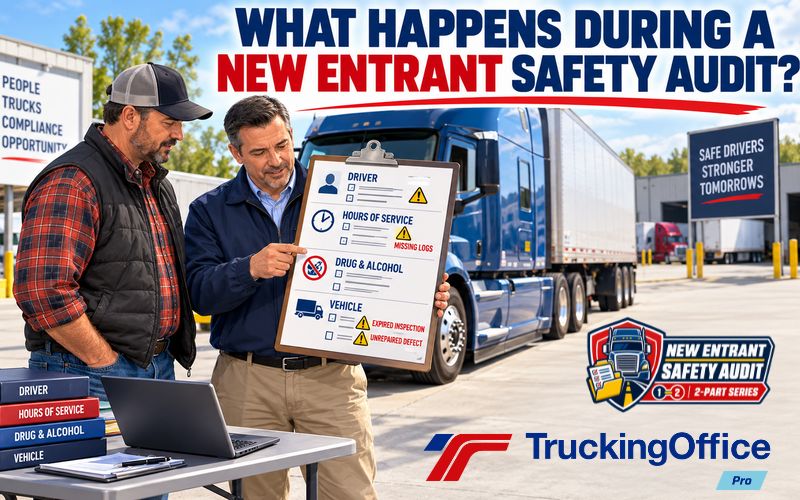
What is the New Entrant Safety Audit?
When your new trucking company gets its operating authority, you’ll hear about the New Entrant Safety Audit from FMCSA.
The New Entrant Safety Audit is a mandatory examination of the company’s records and safety practices. Its purpose is to determine if your company has basic safety management controls to comply with federal safety regulations.
The auditor may come to your offices or conduct the audit electronically. They want to see the required records about drivers, company-level safety, and vehicles.
Why Does FMCSA Conduct the Audit?
The New Entrant Safety Assurance Program is geared to prepare a new motor carrier in the U.S. when they apply for their operating authority. Its goal is to make sure the new company understands and complies with the safety regulations from the start. For 18 months, your company will be monitored for safety issues. In the first 12 months, FMCSA will complete a safety audit of your company.
What is FMCSA?
The Federal Motor Carrier Safety Administration is a branch of the U.S. Department of Transportation. This agency regulates and provides safety oversight of commercial motor vehicles.
When Will FMCSA Contact You?
The FMCSA New Entrant Contact Center will contact you to confirm your carrier registration is correct within 90 days of completing your registration with the agency. This is not when they schedule your safety audit. They will wait for you to begin operations – hauling freight – before they contact you about it.
Be sure you respond to FMCSA’s contact. They can revoke your registration if you don’t.
If you have relocated or have to change your contact information, use Form MCS-150 to notify FMCSA.
This confirmation contact will not be via email. If an email claims to be from the FMCSA, be careful. It may be a scam. FMCSA will not ask for your USDOT pin, credit card number, or charge for downloadable forms in an email. Check for .gov in the sender’s email address and don’t click on any links in the email.
How Does FMCSA Schedule the Audit?
FMCSA will contact you about the New Entrant Safety Audit via phone or by regular mail – not email. They will complete the audit within 12 months of beginning operations. It will be held either at your office or electronically.
If the audit is electronic, you will be asked to submit your records. The auditor will provide instructions on which documents they want to see and what format they want the files in. PDFs are most likely, but if you have images, spreadsheets, DOC files, or paper copies, confirm how they want you to send them.
What Happens During the Audit?
The auditor will check that you provided all the requested documents. For owner-operators, a common mistake is missing driver records. Even if you’re the owner and the only driver, you must include the driver employment application for yourself, as well as the alcohol/drug test results and Clearinghouse queries.
The audit will include an assessment of hours of service (HOS). Supporting documents like fuel receipts and bills of lading (BOL) may be requested to confirm the HOS ELD records.
Vehicle maintenance reviews will include preventive maintenance schedules, inspection reports, and applicable DVIRs.
Complete trucking management software is useful for tracking maintenance records. Programs like TruckingOffice PRO have a maintenance scheduling system for items that are tracked by mileage or by time. If you use the integrated TruckingOffice ELD with TruckingOffice PRO, DVIRs can be accessed as well as the repair records and the scheduled tasks.
The company’s safety records, like roadside inspections, proof of insurance, and safety protocol training, will be examined.
What Are Automatic Failure Violations?
Automatic failure violations are serious problems in the New Entrant Safety Audit. When found, they immediately cause the audit to fail. This could lead to FMCSA shutting down your trucking company unless the problems are corrected or successfully challenged.
The carrier’s documentation or safety protocols can cause the carrier to fail the safety audit. They include drug and alcohol issues, missing safety programs, and allowing unqualified drivers or unsafe vehicles to operate. FMCSA considers the following violations serious enough to cause automatic failure of the New Entrant Safety Audit.
FMCSA identifies 16 regulatory violations that can cause automatic failure. Several overlap, so the related violations are grouped below.
Drug and Alcohol Violations:
| Violation | Explanation |
|---|---|
| No drug /alcohol testing program | You are required to have a compliant DOT testing program. |
| No random drug/alcohol testing | Your testing program must run random drug and alcohol tests. As an owner-operator, you must join a consortium, which will randomly select from its membership for drug testing. You must report to the designated clinic for the test. Being the only driver in a trucking company does not exempt you from this requirement. |
| Using a driver with alcohol of 0.04 or higher | A driver who tests at 0.04 or higher cannot drive again until completing the return-to-duty process. |
| Using a driver who refused a required test | A driver who refuses to take a legally required breathalyzer, alcohol test, or drug screen cannot keep driving. |
| Using a driver who tested positive for drugs | A driver with a verified positive DOT drug test cannot drive. The driver must complete the return-to-duty process before returning. Because this is a federal law, state laws that permit marijuana recreational or medical use are not excuses. Some CBD products contain enough THC to test positive. |
Driver Qualifications:
| Violation | Explanation |
|---|---|
| Invalid CDL | Knowingly permitting a driver to operate with an expired CDL, the wrong CDL class, or without required endorsements to operate a commercial vehicle. |
| Disqualified Driver | Knowingly allowing a driver who has been legally banned by federal or state regulations due to suspension for major traffic offense, DUI, or serious safety violation to operate a commercial vehicle. |
| Suspended or Revoked CDL | Knowingly allowing a driver with a suspended, revoked, or canceled CDL by the state DMV to operate a commercial vehicle. |
| Medically Unqualified | Knowingly allowing a driver who does not meet FMCSA’s medical qualification requirements to operate a commercial vehicle. |
Vehicle Maintenance Violations:
| Violation | Explanation |
|---|---|
| Operating an Out-of-Service Vehicle | At a roadside inspection, if a truck is declared out of service (OOS), it cannot be driven until the repairs are completed on site or the truck is hauled to a repair location. |
| Ignoring DVIR reported issues | Operating a vehicle with out-of-service issues reported on a DVIR that has not been repaired. |
| Missing Periodic Inspections | Letting your mandatory annual truck and trailer inspection go past the 12-month requirement. Automatic failure occurs when 51% or more of the vehicles checked have expired inspections. |
Company-Level Safety/Operations Violations
| Violation | Explanation |
|---|---|
| Lack of Insurance | Operating without minimum regulatory insurance. |
| Missing Hours of Service (HOS) Records | Failing to require drivers to maintain records of duty status. Automatic failure occurs when 51% or more of the records examined are missing. |
The auditor may also examine accident records and applicable safety-training records. These records are important to the audit even though they are not listed as separate automatic-failure violations.

Are Your Audit Warning Lights On?
Your truck’s dashboard isn’t the only place where warning lights appear. Choose the best answer for each question.
1. You’re the owner, dispatcher, safety manager, and only driver. Do you need a random drug and alcohol testing program?
- No. I already know I’m trustworthy.
- Only when I hire another driver.
- Yes. I must join a consortium’s random testing pool.
- Only if FMCSA sends me a Groupon.
2. The auditor asks for your hours-of-service records. How many can be missing before the automatic-failure rule applies?
- One record with coffee spilled on it
- 25% of the records examined
- 51% or more of the records examined
- All the ones from weeks I would rather forget
3. A roadside inspector places your truck out of service. When can you drive it again?
- When the inspector leaves
- When the repair shop is only two exits away
- When the dashboard warning light turns off
- After the out-of-service defects are repaired
4. How often do your truck and trailer need periodic inspections?
- At least once every 12 months
- Whenever the tires start looking worried
- Every 100,000 miles
- The week before the Safety Audit
5. Which driver is qualified to take the next load?
- A driver with an expired CDL
- A driver whose CDL is suspended
- A properly licensed and medically qualified driver
- A driver who promises to renew everything on Friday
Answer Key
- C: A one-driver company still needs a compliant random testing program.
- C: Missing 51% or more of the examined HOS records triggers automatic failure.
- D: An out-of-service truck cannot be driven until its out-of-service defects are repaired.
- A: Each truck and trailer needs a periodic inspection at least once every 12 months.
- C: The driver needs the proper license, endorsements, and current medical qualification.
What Happens When You Pass the Safety Audit?
Passing the audit completes one major requirement of the New Entrant program. You will remain under the New Entrant monitoring for the remainder of the 18 months.
When you complete the 18 months, FMCSA will grant permanent operating authority if you passed the audit and had no additional safety problems. Your company will continue to be monitored through the regular CSA program.
What Happens If You Fail the New Entrant Safety Audit?
If you fail the audit, FMCSA will send you a written failure notice to tell you that your USDOT new entrant registration is scheduled to be revoked because of inadequate safety management controls.
You must respond to the notice and demonstrate your corrective actions.
If you haul hazmat that requires placards, you have 45 days to prove you fixed the problems. Other trucking companies have 60 days.
You are required to submit a Corrective Action Plan (CAP). You can’t just promise to “do better next time.” You have homework.
- Provide an honest breakdown of why your company’s safety control(s) failed. It should be a detailed explanation of what went wrong. Don’t blame-shift on this one. It’s your company, and you’re responsible for understanding the safety regulations.
- Show concrete proof that you fixed the specific violations. Common owner-operator violations often involve driver qualifications. Owner-operators think they don’t have to fulfill those requirements. You’ll find that you do have to submit to the drug and alcohol testing requirements.
- Explain how you prevent these problems from recurring. These often refer to training and new systems you put in place.
It feels like homework, doesn’t it? Explain what went wrong and provide proof of how you fixed it.
If this letter sounds like you’re groveling… well, stay professional, accept the blame for the problems, and remember this lesson. You don’t want to write this type of letter twice.
Multiple safety failures can lead to consequences. An unacceptable or late response may result in revoked registration, and you may be put out of service.
Complete trucking management software (TMS) can help you stay on top of those tasks to stay compliant. Keeping driver records in a TMS, along with vehicle maintenance records, makes it quick and simple to retrieve records and schedule compliance tasks. TruckingOffice PRO has the tools you need to build a successful trucking company.
Try our free 30-day trial to look at everything in TruckingOffice PRO. Unlike some other companies that give you only a week or two, or block off some parts of the program until you sign a contract, TruckingOffice gives you the keys to the entire platform. You can see it all and discover how TruckingOffice can help you right now.

Recent Comments