


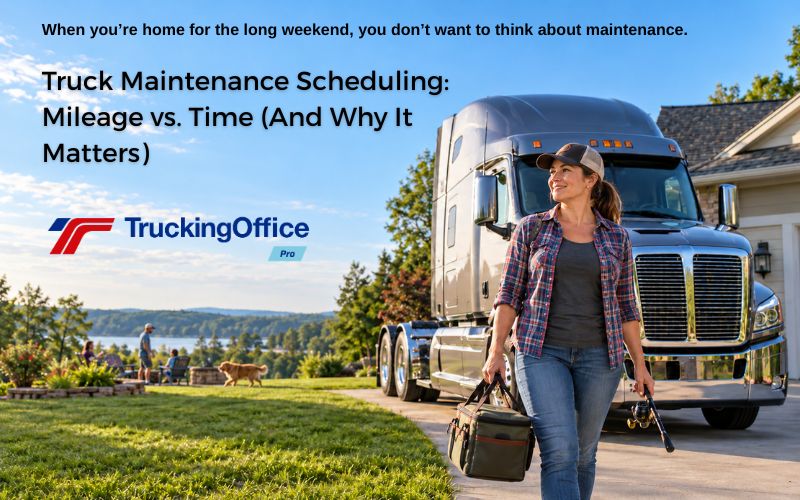
On Friday morning while driving from Canton to Akron on I-77, I counted 10 empty flatbed trucks, 5 bob-tail cabs, and 3 speed-traps. It must be Memorial Day Weekend. Welcome to Summer – and the first long weekend we have at home. What are you going to do with it? Worry about your truck maintenance or relax with your family?
For more on planning service intervals, read Do You Love Truck Maintenance? and build a schedule you will actually follow.
What Should You Check Before Your Next Trip?
After a long weekend, getting back up in the big seat on Tuesday might feel like things are back to normal. Hauling freight is your comfortable routine, like Raisin Bran for breakfast.
What’s the first thing you do? Inspect your truck or check the rate con?
It doesn’t matter, as long as you do both before you turn the key.
According to the DOT, the pre-trip inspection should cover:
- Service brakes, including trailer brake connections
- Parking (hand) brake
- Steering mechanism
- Lighting devices and reflectors
- Tires
- Horn
- Windshield wiper or wipers
- Rear-vision mirror or mirrors
- Coupling devices
- Wheels and rims
- Emergency equipment.
Make decisions about any safety defects before starting the engine. Do you need to buy new wiper blades before you get on the highway? Do the headlight wires need to be adjusted or replaced? This inspection isn’t going to find every problem, but checking everyday will give you familiarity with your rig. When something is about to go wrong, you might spot it first.
As important as the daily inspection is the planned maintenance plan.
Is a DVIR Part of a Planned Maintenance Schedule?
No. A driver vehicle inspection report (DVIR) records defects a driver discovers or learns about during the workday when a report is required. The preventive truck maintenance schedule is a timetable for replacements or maintenance, even when nothing seems wrong. A safety defect reported on a DVIR needs to be addressed. It doesn’t wait for the next scheduled service.
What Does Preventive Truck Maintenance Include?
Preventive truck maintenance by a trucker is a four-step process.
- Regular truck inspection
- Schedule routine service
- Repair defects and regular maintenance tasks like oil changes, filter changes, and tire rotation
- Record the work – who did it and when.
Take window wiper blades. You barely notice them when they work. In some parts of the U.S., wiper replacement is something you think about during the monsoon season. But if you live in the Midwest, you might plan to replace them three or four times a year.
The key is a PLAN, not managing when something goes wrong. By thinking forward, you can schedule work to be done on your truck on your time.
The challenge is that many things on your truck require maintenance based on miles, not time. And other things have both mileage and time limits. So how do you track that?
Which Maintenance Should You Schedule Ahead?
FMCSA does not tell you how often to service your vehicle. Nice to see the government express some common sense, because different vehicles and trailers need different schedules. But you can plan ahead when you know your business.
If you’re scheduling maintenance, check your truck’s service recommendations. Some jobs come due by miles or time, whichever comes first.
| Schedule by miles driven | Schedule by time |
|---|---|
| Engine oil and filter service* | Annual DOT vehicle inspection |
| Transmission and differential fluid service | Seasonal heating, air conditioning and battery checks |
| Brakes service* | Coolant conditon check (summer and winter) |
| Chassis lubrication | Emergency equipment inspection |
*These may be scheduled based on mileage or time. Consult your manuals for specifics.
Group your routine work based on your equipment’s service recommendations. Scheduling by time is simple – count the months and make the appointments with the trusty techs who know your truck.
Scheduling by miles takes a bit more awareness of how many miles you drive each month. It’s better for your truck to get fresh oil a little earlier rather than later. Trusting your technician and their supplies is better for your blood pressure than some random dude you find when the magic number rolls over on your odometer.
To know when your mile-related work will be done frees you from trying to pick a load that suits your truck’s mileage. If you know that next Tuesday, you’ve got an appointment 10 minutes from home, you don’t take a cross-country load that week. That’s got to be better than hoping you’ll find an open service bay with time to take care of your rig – and wasting HOS while it’s done.
What Does Putting Off Truck Maintenance Cost?
Every year, the annual multi-day roadside inspection blitz, CVSA Roadcheck, inspects trucks for safety issues. It shouldn’t be the only motivation to keep your rig maintained. Nor should it be a reason to stay off the roads that week.
What worries a trucker more than Roadcheck? A breakdown on the road, especially with a load on the trailer. Now you’re paying for repairs while the truck isn’t earning a dime.
Whether it’s worn-out tires, a broken fuel pump, or old straps failing when the exit ramp goes one way and your load goes the other, those problems can cost far more when you’re on the road. Regular, scheduled maintenance can reduce your worry when you see the inspector approach during the Roadcheck.
By preparing in advance, you’re not only saving money. You’re saving yourself from the headaches of an out-of-service order along I-77. You may be saving your own life by keeping your rig safe and preventing an accident.
How to Schedule Your Preventive Truck Maintenance
Good preventive maintenance is cyclical. You do it once, and you immediately decide when the next appointment should be. It’s not based on a calendar alone. It’s based on what your equipment manuals tell you, so you don’t have to remember it next year like your wedding anniversary. It’s more complicated. (Don’t tell your spouse I said that.)
Nothing is on the same schedule. Tires and oil changes are not going to hit on the same day (Thank God!) But you have to remember them. Calendars? They could work. As long as you have next year’s calendar in your back pocket in November when you need that next oil change.
Sure, Google Calendar would work. But it’s double entry – and subject to your memory – did you do it?
TruckingOffice PRO Handles Your Maintenance Records and Schedules
DOT requires carriers to keep vehicle maintenance records, but they can do double duty for you.
TruckingOffice PRO takes what you enter into the system and handles the memory issues for you. It will remind you to schedule appointments with your technicians or the tire salesman who gives you a repeat-customer discount. You’ll find that entering the data one time is far more efficient than trying to remember the last time you had your brakes serviced.
This weekend, you don’t want to worry. You want to fish, play with the kids, or take your spouse out for dinner (anniversary or not). So why not give TruckingOffice PRO a try for free? You can get a free trial and give your brain the rest it needs when you’re off the road.

Updated September, 2026


Great article!