


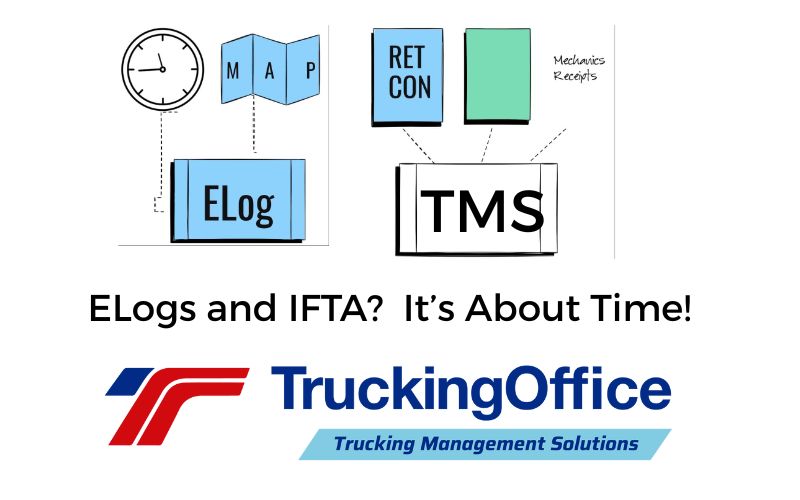
If you’re in long distance trucking, you know those abbreviations. ELogs – electronic logging for drivers for hours of service. (There’s another abbreviation — HOS.) IFTA – International Fuel Tax Agreement – is that quarterly tax based on miles per jurisdiction or state. Most people don’t put ELogs and IFTA together – but it makes sense. ELogs that track location. IFTA is based on locations. So why wouldn’t you want the data tracked by the ELog used to compute your IFTA?
Linked ELD and IFTA data also gives you the contemporaneous mileage records covered in our IFTA audit checklist.
ELD and IFTA integration means the state-by-state mileage your electronic logging device already records flows straight into your quarterly IFTA fuel tax report, with no re-entry. An ELog tracks where the truck is and how far it runs in each jurisdiction. IFTA is a tax based on exactly that. When the ELog and your fuel expense records live in the same trucking software, the IFTA report builds itself.
Of course you want it!
IFTA Steals Time (and Income)
It’s hard to remember computing a complicated tax like IFTA by hand, much less doing it four times a year. Old truckers remember losing a day on the road every January, April, July, and October. On top of the hours off the road, the IRS expected accuracy. The penalties and fines scared us. Truckers would take a day to compute and fill out the forms, and then another day with an IRS agent. That’s a lot of billable time that wouldn’t be paid.
If a driver forgot to write down the mileage per state, then the best they could do was guess. (The IRS doesn’t like guesses.)
That’s why an ELog that tracks locations is so valuable. That level of accuracy is what we need for IFTA.
But how do you get those records into an IFTA report?
ELogs and IFTA Integration with Trucking Management Software
An IFTA report that has the ELOG accuracy we need? Sounds great! How do we get it?
Because a ELog doesn’t track fuel purchases.
Nope, it doesn’t. For that, you need a system that tracks expenses.
Ideally, a system that takes the receipts from the fuel pump and enters them by scanning, not by typing. (Wouldn’t that sweet?) Then the computer system will combine the fuel expenses – per state – and the miles per state in a single IFTA report. That’s what we need.
So what we need is an ELog that works with a trucking business software that tracks the finances as well as dispatches, routes, invoices, and maintenance.
ELog and IFTA Integration? That’s not asking too much, is it?
Not if you’re asking TruckingOffice. Our trucking management software handles all of those tasks and integrates with our TruckingOffice ELog (also known as TruckingOffice ELD).
When you’re adding fuel purchases to the TruckingOffice PRO for business expenses (and our awesome Trucker Stats™ business reports!), the same data is also used for an IFTA report. No re-entry needed. No extra time wasted.
It is the 21st century. It’s about time that we automate our trucking businesses by integrating IFTA and Elogs.
ELogs and IFTA integration is an obvious application for the trucking industry and for owner operators in particular. Anything that keeps us on the road and away from unprofitable time in front of a computer screen needs to be updated now.
Want more information on how to make your trucking business grow and succeed? TruckingOffice has options to support your trucking company. Trucker Stats™ are the tools you need to find your cost per mile and other statistics that can show where your company is doing great and where it needs your attention.
ELogs and IFTA: Frequently Asked Questions
Does an ELD track IFTA miles?
Yes. An ELog records the truck’s location, so it captures the miles driven in each state or jurisdiction — the exact figure an IFTA report is built on. That location accuracy is what makes ELog data so valuable for IFTA.
Does an ELD track fuel purchases?
No. An ELD does not track fuel purchases. An IFTA report needs miles per state and fuel bought per state, so you also need a system that tracks expenses — ideally one that captures fuel receipts by scanning instead of typing.
What is ELogs and IFTA integration?
ELogs and IFTA integration is a setup where the mileage your ELog records and the fuel expenses your trucking software records are combined into a single IFTA report. Because both sets of data live in one system, there is no re-entry and no separate spreadsheet.
Why does filing IFTA by hand take so long?
IFTA is a complicated tax that has to be computed four times a year. Truckers who did it by hand often lost a day off the road every January, April, July and October, and a driver who forgot to write down mileage per state was left guessing.
How does TruckingOffice combine ELD and IFTA reporting?
TruckingOffice PRO trucking management software integrates with the TruckingOffice ELog, also known as the TruckingOffice ELD. When you add fuel purchases as business expenses, the same data is used for your IFTA report — no re-entry and no extra time wasted.
TruckingOffice Trucking Management Software
Welcome to the 21st Century trucking management software for your owner operator trucking company!
TruckingOffice offers the best options for the solo trucker or the fleet builder. We’ve got affordable trucking management software that handles everything, including automatic rate con load entry. TruckingOffice PRO with TruckingOffice ELog makes your life easier and managing your business smoother by helping you handle your tasks better and faster:
- dispatches
- routing
- invoice generation and tracking
- expense management
- IFTA and IRP
- maintenance
- Trucker Stats™– reports to show the state of your trucking business.
Combined with the TruckingOffice Electronic Logging Device, you’ve got everything you need to build a successful trucking business – even from the cab of your truck.
Contact us today to try TruckingOffice PRO free trial help you avoid loads that cost you money to deliver and to discover what equipment is the most profitable for you.


Recent Comments