


How Does Your TMS Use ELD Mileage?
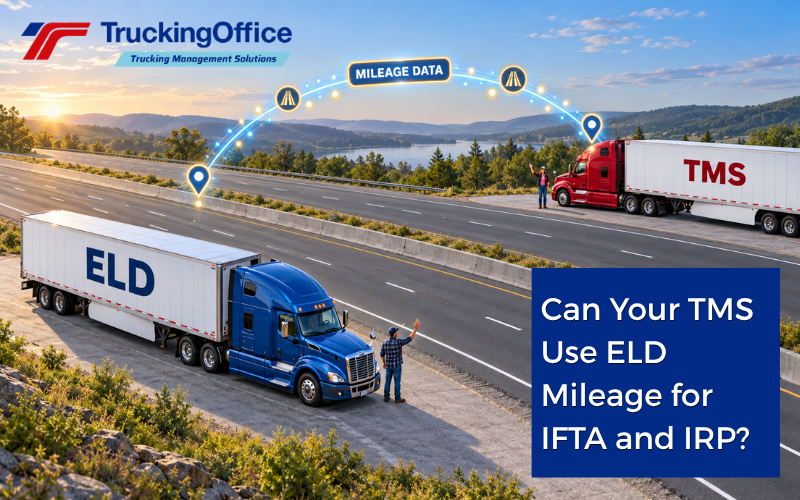
A trucking management system (TMS) can use mileage from an electronic logging device (ELD) when the two systems have a compatible connection. The ELD supplies location and vehicle mileage data, and the TMS uses it to organize distance by jurisdiction. When fuel purchases are recorded in the TMS, the software can prepare information for quarterly IFTA returns and organize mileage for the applicable IRP reporting period. The carrier must still review the records, file the IFTA return, and complete the IRP renewal.
What Information Can an ELD Send to a TMS?
Depending on the integration, an ELD can send location, vehicle mileage, and HOS information to the TMS. Some connections may also send load and dispatch information from the TMS to the driver application. For an owner-operator, that exchange can reduce repeated mileage entry and make IFTA, IRP, and load planning information easier to access.
What is IFTA?
IFTA stands for International Fuel Tax Agreement. It allows qualifying interstate carriers to report and pay fuel use taxes through one base jurisdiction instead of dealing separately with every participating jurisdiction where they travel.
What is IRP?
IRP stands for International Registration Plan, an agreement among participating U.S. and Canadian jurisdictions that apportions commercial vehicle registration fees according to the distance a fleet travels in each jurisdiction.
What is Hours of Service (HOS)?
Hours of Service (HOS) regulations control how long commercial drivers may drive and remain on duty, along with required breaks and off-duty periods.
That’s a lot of letters that don’t mean much outside the trucking industry, but accuracy in all three matters. You don’t want to underpay or overpay fuel taxes or apportioned registration fees. And Heaven help you if an inspector checks your log when you’re over your HOS limits. Integration doesn’t eliminate those responsibilities, but it can make the information easier to track.
Why Should You Integrate Your TMS and ELD?
With a compatible connection, HOS information, truck location, and jurisdiction mileage can move into the TMS automatically. That means less typing, easier load planning, and fewer numbers to track down when IFTA or IRP is due.
- Faster Communication. Drivers can receive dispatch and delivery updates when the connection supports two-way communication.
- Improved tax visibility. Running an IFTA report during the quarter can help estimate the company’s fuel-tax obligation. The owner-operator can then set money aside instead of discovering the entire amount when the return is due. Having cash on hand beats putting another business expense on a credit card.
- Reduced mileage entry. Jurisdiction mileage can move from the ELD into the TMS without someone typing the same numbers into another program.
- Faster report preparation. The TMS can organize mileage for IFTA reports and the applicable IRP reporting period.
Trucking management software does not replace an ELog device or a driver log. The driver must still review the HOS records, make any permitted corrections, and certify them through the ELD. The TMS may display HOS information, but the ELD remains the official log.
How Does ELD Integration Help with IFTA and IRP Reporting?
An ELD collects location and vehicle-mileage data. With a compatible connection, that information moves into the TMS, where it can be organized by jurisdiction. When fuel purchases are entered or imported, the TMS can combine the fuel and distance information needed to prepare an IFTA report.
IRP also uses jurisdiction mileage, but the carrier must use the mileage from the reporting period specified for its renewal. TruckingOffice PRO can organize those records and shorten the preparation time for both programs. The carrier must still review the information before filing the IFTA return or completing the IRP renewal.
Take the Quiz

Can Your TMS Use Your ELD Mileage?
Your ELD records miles. Your TMS creates reports. Do they work together—or just wave at each other from opposite sides of the internet?
Score your answers:
🟢 = 2 points 🟡 = 1 point 🔴 = 0 points
1. Does mileage move from the ELD into the TMS?
🟢 Yes. Location and vehicle mileage data move automatically through a compatible connection. Nobody has to type the odometer reading twice.
🟡 Sort of. Someone exports a file, uploads it, and hopes all the columns arrive in the same order.
🔴 No. The ELD knows where the truck went, but it has taken a vow of silence.
2. Does the TMS organize the mileage by jurisdiction?
🟢 Yes. The TMS organizes the mileage by state or province so the carrier can review it.
🟡 It provides total mileage, but crossing state lines remains a do-it-yourself project.
🔴 Jurisdiction mileage gets reconstructed from fuel receipts, toll records, and the vague recollection that “Oklahoma was in there somewhere.”
3. Can the TMS use the mileage to prepare IFTA information?
🟢 Yes. The TMS combines jurisdiction mileage with the fuel purchases entered into the system and prepares an IFTA report for review.
🟡 The mileage and fuel records exist, but introducing them requires three programs and one suspicious spreadsheet.
🔴 IFTA preparation begins with a calculator, a pile of receipts, and the sudden urge to change careers.
4. Can the TMS organize mileage for the correct IRP reporting period?
🟢 Yes. The TMS organizes jurisdiction mileage for the applicable IRP reporting period so the carrier can use it for the renewal.
🟡 It has the mileage, but someone must sort the dates and build the IRP totals manually.
🔴 The IRP plan consists of submitting the last IFTA report and hoping nobody notices. Spoiler: That is not a plan.
How Did Your ELD–TMS Mileage Connection Score?
7–8 points: Road Ready
Your mileage travels from the ELD to useful reports without taking the scenic route. Review the records, complete the filing or renewal, and move on.
4–6 points: Check the Warning Lights
The connection saves some time, but someone still has to move files, sort dates, or wrestle with IFTA-FINAL-FINAL-USE-THIS-ONE.xlsx.
0–3 points: Put It Out of Service
Your ELD and TMS may technically be connected, but so are two truckers waving at each other across six lanes of interstate. Ask better questions—or keep shopping.
What Should You Ask Before You Buy?
Before investing in either a TMS or an ELD – especially if you have to sign a year-long contract – decide what you need to run your trucking business.
Make a list of the features you want. When you research what’s in your price range, cross off the products that don’t meet your needs.
Before you buy, ask:
- Does this TMS connect with my specific ELD?
- Does mileage transfer automatically, or must I export a file?
- Does the system organize mileage by state and province?
- Can it combine mileage with fuel purchases for IFTA?
- Can it use the correct reporting period for an IRP renewal?
- What do the TMS, ELD hardware, data service, and integration cost altogether?
Your ELD and TMS don’t need to perform every task offered by an enterprise fleet system. They need to share the information your business actually uses—and turn your mileage into reports without sending you back to a spreadsheet.
If you’re hesitant to sign a year-long contract for either a TMS or an ELD, consider TruckingOffice PRO and TruckingOffice ELD. You can sign up for a free TMS trial and for the month-to-month ELD service while deciding what works for your business.


Recent Comments