


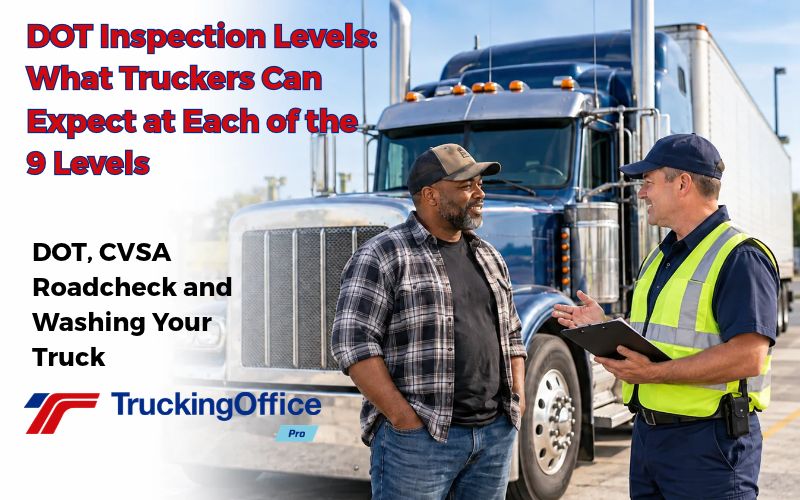
In high school, it was that feeling you had right before the test. Did you study enough (at all)? It’s the same feeling when the lights flash behind you on the road, and you realize you’re about to be inspected. You check your watch. You find your binder with your documentation and feel that truck stop taco gurgle in your belly.
It’s the foreboding in the pit of your stomach that you can’t control.
As the officer approaches your window, you have that moment to decide how you’ll handle the next hour. It might feel like 20 years.
Knowing that you’ve prepared yourself, your records, and your rig for a DOT inspection helps. But what can you expect from a DOT roadside inspection?
What is a DOT Inspection?
The Department of Transportation (DOT) inspection is a safety inspection of a commercial truck. According to FMCSA, a Full Inspection is the same as a Level 1.
Is the CVSA Roadcheck also a DOT inspection?
Yes. Inspections conducted during CVSA International Roadcheck are DOT roadside inspections. Roadcheck is the coordinated three-day event when inspectors conduct those inspections using the same standards applied throughout the year. Most are Level 1 inspections, although other levels are conducted.
What is the CVSA Roadcheck?
A CVSA International Roadcheck is an annually scheduled vehicle inspection event. Usually held in May, the Commercial Vehicle Safety Alliance announces the specific focus that the inspectors will examine. But they aren’t limited to those safety concerns. They’ll inspect the truck, the trailer, your documents, and even you if they think you’re driving under the influence.
During Roadcheck, commercial trucks may be directed into weigh stations, inspection stations, or roadside locations for inspections, primarily Level 1. During the 2026 Roadcheck, CVSA reported they completed 54,575 inspections in Canada, Mexico, and the U.S. in 72 hours.
What’s the difference between Roadcheck and DOT Inspections?
Not a lot of difference, although the announced scheduling of the Roadcheck vs. the random DOT inspection might be the most obvious. The same inspection standards that are applied throughout the year are used at the Roadcheck.
CVSA Roadcheck vs. Regular DOT Inspection
| Comparison | CVSA International Roadcheck | Regular DOT Inspection |
| When | Three announced days each year, usually in May | Any time throughout the year |
| Who conducts it | Commercial vehicle enforcement officers across North America | DOT-authorized commercial vehicle inspectors |
| Where | Weigh stations, inspection stations, and roadside locations | Weigh stations, inspection stations, and roadside locations |
| Inspection levels | Primarily Level 1, but other levels may be conducted | Any applicable inspection level |
| Special focus | CVSA announces specific driver and vehicle safety focus areas each year | No single annual campaign focus |
| Violations | Can result in citations and out-of-service orders | Can result in citations and out-of-service orders |
| CVSA decal | Qualifying vehicles may receive a CVSA inspection decal | Qualifying vehicles may also receive a decal |
Because this event is so massive, participating enforcement agencies put additional inspectors to work. Some truckers report they get through it very quickly. This probably depends on what time of day and where the inspection was held.
Some truckers want to avoid the Roadcheck inspection. They’ll take an alternative route that they think is unlikely to have an inspection site or may take them to a less congested inspection station.
You must stop at a required stop (weigh station, inspection location, or an officer directing you into a stop).
By taking an alternative route, you can perhaps delay the inspection to a stop that is less congested. But don’t count on it.
After your CVSA inspection, you still have to stop at every required stop. But your inspection decal might get you on your way quicker because they don’t want to re-inspect vehicles. Sadly, you may have to wait. Again.
Some drivers choose to take Roadcheck week for their vacation. If you are concerned about being put out of service, ask yourself: should this truck be on the road? The purpose of these inspections is to keep the roads safe for all drivers.
The best way to prepare for a DOT inspection or the Roadcheck is to keep up with your truck’s maintenance schedule. TruckingOffice has a maintenance records and schedule module to help you track the work your rig requires.
Can a Level 1 DOT Inspection Replace Your Annual Inspection?
No. FMCSA says that a violation-free Level 1 or Level 5 roadside inspection does not fulfill the federal annual inspection requirement. The CVSA decal and the annual DOT inspection sticker are not the same.
The Level 1 inspection checks your truck and driver for safety violations. The annual inspection examines the vehicle under federal periodic inspection standards and must be completed at least once every 12 months.
Should You Wash Your Truck Before an Inspection?
Washing your truck probably won’t help. It can’t hurt – show your pride in your ride. What will help is to have your documents in order and a pleasant attitude toward the inspectors who are doing their best to get you through this inspection as quickly as possible.
DOT Roadside Inspection Levels
Unexpectedly, the nine levels aren’t exactly in order based on the depth of the inspection. Level 1 is a comprehensive inspection, including examinations under the truck. Level 2 is slightly less exacting by eliminating the crawl under the truck. Maybe they decided to label them according to popularity. Who doesn’t want their underside examined?
The Commercial Vehicle Safety Alliance (CVSA) recognizes nine levels of commercial vehicle inspections.
Level 1: North American Standard Inspection
This is the most comprehensive and thorough of the inspections. It involves extensive vehicle checks – including under-the-vehicle – and examination of hours-of-service logs. It is also sometimes referred to as the North American Standard (NAS). It is not scheduled and may take place at a weigh station, roadside locations, or an inspection facility. For this article, we have omitted the passenger vehicle requirements.
| Driver |
| Driver’s license (CDL or non-CDL) |
| Medical examiner’s certificate, if applicable (aka medical card) |
| Skill Performance Evaluation (SPE) Certificate, if applicable |
| Alcohol and drug use or impairment |
| Seat belt use |
| Administrative Records |
| Driver’s record of duty status (RODS) as required |
| Hours of service (HOS) compliance |
| Vehicle inspection reports, if applicable |
| Truck and Trailer |
| Brake systems |
| Cargo securement |
| Coupling devices |
| Driveline/driveshaft |
| Exhaust systems |
| Frames |
| Fuel systems |
| Lighting devices (headlamps, tail lamps, stop lamps, turn signals, and lamps/flags on projecting loads) |
| Steering mechanisms |
| Tires |
| Van and open-top trailer bodies |
| Wheels, rims, and hubs |
| Windshield wipers |
| Hazardous materials/dangerous goods (HM/DG) requirements, when applicable |
| Specification cargo tank requirements, when applicable |
| Suspension systems |
Shouldn’t they buy you a drink after that? Not if you’re driving.
Level 2: Walk-Around Driver/Vehicle Inspection
This examination looks at the driver and vehicle without requiring inspectors to go underneath the truck. The inspectors will still want to see your driver qualifications, HOS compliance, and applicable records.
Level 1 vs. Level 2 DOT Inspection
| Inspection | Level 1 | Level 2 |
| Driver qualifications | Yes | Yes |
| HOS and required records | Yes | Yes |
| Brakes, tires, lights, and other accessible components | Yes | Yes |
| Inspection underneath the truck | Yes | No |
| Out-of-service violations possible | Yes | Yes |
The inspector can still order you out of service with this level, so take it seriously. Safety first, right?
Level 3: Driver/Credential/Administrative Inspection
This inspection focuses on the driver’s qualifications, license, hours of service, and other required records. Keep your documents well organized in a binder or accordion folder. Know how to use your ELD to transfer your HOS report.
Your lawyer might prefer you use paper copies in a binder.
Level 4: Special Inspections
A one-time examination of a specific item, often conducted for research or to investigate a particular safety concern.
For example, the inspector might focus on brakes. If they’re trying to investigate a pattern of brake failures, they might want to look at your rig to collect data. Instead of checking everything on the truck, they may want to gather information about a specific system or problem.
It’s not you. It’s them.
Level 5: Vehicle-Only Inspection
This inspection uses the same vehicle inspection procedures from Level 1 without the driver present. This won’t often apply to an owner-operator. These inspections are more commonly used for fleets parked in a terminal or yard. Level 5 inspections can also take place on the road, including during Roadcheck.
Level 6: Enhanced NAS Inspection for Radioactive Shipments
A specialized inspection for shipments of certain radioactive materials.
If you’re hauling hazmat, they’re going to check you over good – and better if you haul nuclear waste or other radioactive material. IYKYK.
Level 7: Jurisdictional Mandated Commercial Vehicle Inspection
An inspection required by a state, province, or other jurisdiction, often for specific vehicles such as school buses. Not applicable to most owner-operators.
Level 8: North American Standard Electronic Inspection
An electronic inspection that verifies specified driver and vehicle information without a traditional roadside stop. It uses electronically transmitted data instead of requiring the driver to pull into an inspection station. In other words, they’re doing this inspection without the truck stopping. This is a voluntary program. For now.
Are you worried about that? 👀
DOT has now established a Level 9 Inspection.
Level 9: Post-Crash Inspection
CVSA added a new inspection for motor vehicles after a crash. They want to investigate the vehicle’s condition and potential mechanical or safety-related factors after a crash involving a fatality, serious physical injury, a high-profile commercial-vehicle crash, or when a jurisdiction requires it.
Did you see the movie Sully? This inspection might be slightly less intense. Slightly.
Keep Your Truck on the Road, Not Out of Service
We’re gonna guess that you know what’s wrong with your rig. You spend hours in it. You know the weird wiggle when you pull on the interstate and that odd click when you press the brake pedal.
Yes, paying for those repairs can cost a lot of money – maybe money you don’t have. DOT inspectors want to take unsafe vehicles off the road, not because they have it out for you. They want to protect you and everyone else on the road.
Using TruckingOffice’s vehicle maintenance options, you can monitor your truck’s maintenance:
- Track repairs, the techs who did them, and where and when they were taken care of.
- Schedule future work by miles or by time.
- Have the records handy that you need for an inspector or an auditor.
See how TruckingOffice helps you keep inspection-ready maintenance records. Start your free 30-day trial.
Read these other DOT Inspection blogposts

Updated October 2026
Do the DOT inspections consider manufacturer guidelines for frame mods. Thus would holes drilled in the frame against manufacture guidelines be a finding as the frame could be compromised?