


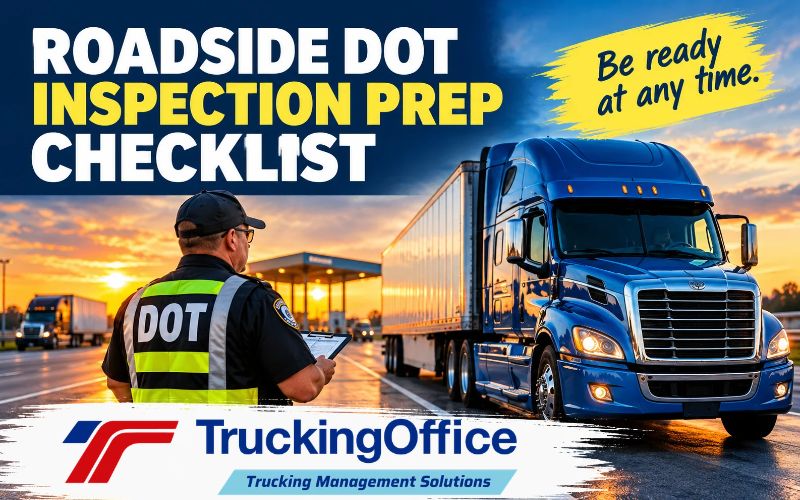
“Prepare before you’re pulled over.” That’s the best advice you’ll get about roadside DOT inspections.
How Do You Prepare for a Roadside DOT Inspection?
Check your truck before driving, keep your required documents available, make sure your HOS records are current, and know how to display or transfer your ELD logs if you use an ELD. Check your cargo securement, and correct safety problems before hitting the road.

When Will the DOT Inspect Your Truck?
When will you face a DOT inspector? There are some scheduled DOT inspection events.
The Commercial Vehicle Safety Alliance CVSA International Roadcheck is scheduled annually, usually in the spring. Every year, a specific target is set and the dates announced.
But most inspections are not scheduled for individual truckers. DOT officers may select trucks at weigh stations, inspection facilities, or roadside enforcement locations without any notice. If an officer notices a problem with a vehicle, suspects violations or safety concerns, they may stop the driver on the road. There may be an inspection after an accident.
There’s no appointment, no warning. This is why you need to be prepared at any time.
The flashing lights come on. A DOT officer directs you to pull over for an inspection.
Are you cool, calm, and collected? Slightly nervous but prepared? Or wondering whether you remembered everything you’re supposed to have?
Skip Graphic to Checklist
Take this quiz to find out what kind of trucker you are when DOT comes calling.

What Kind of Trucker Are You at a DOT Inspection?
1. When was your last pre-trip inspection?
- This morning. I’ve been doing these so long I could probably inspect a truck in my sleep. But I don’t.
- This morning. Everything checked out. Except my patience.
- This morning. I checked everything on my list. I’m still learning what half of it does.
- This morning. I even checked the stuff that hasn’t broken since 2017.
2. The DOT officer asks for your registration and insurance information. What happens?
- I hand them over. No drama. No scavenger hunt.
- I know exactly where they are. Well, within three folders.
- I have them! I just hope these are the right documents.
- They’re in a labeled folder. Alphabetized. Don’t judge me.
3. The officer wants to review your HOS records.
- No problem. I know my ELD better than I know my brother-in-law.
- My logs are current. Now, where did they put that transfer button?
- I’ve got my logs. Nobody mentioned there would be a technology demonstration.
- I’ve practiced displaying and transferring them. Twice. Just in case.
4. During your pre-trip, you discover a tire problem. What do you do?
- Check it, figure out what’s wrong, and get it fixed before driving if it’s unsafe. Tires aren’t something I gamble with.
- Get it checked and arrange service if needed. Then call dispatch and ruin somebody’s schedule.
- I know enough not to drive on a questionable tire. Now I need somebody to explain what I’m looking at.
- I’ve got the tire service number, maintenance records, and a backup plan. I might have a backup for the backup.
5. How do you keep track of your truck maintenance?
- I know what’s been done and what’s due. My truck and I have a long-term relationship.
- I’ve got all the receipts. They’re just participating in an ongoing game of hide-and-seek.
- I’m keeping records. I’m just discovering there’s a whole lot more to trucking than steering.
- Maintenance schedule, service records, reminders. My truck gets more reminders than my phone on my birthday.
6. The DOT inspection ends. What’s your first thought?
- “Thanks, officer. See you next time. Preferably not tomorrow.”
- “That went pretty well. I really should organize those folders.”
- “Well, I learned six new things. I wonder what they’ll ask next time.”
- “Excellent. Now I can update my inspection records.”
Answer Key: Meet Your DOT Inspection Personality
Count your A, B, C, and D answers. Your most frequent letter reveals your DOT inspection personality.
Mostly A’s: Bob “Double Stack” Dawson
The Dependable Veteran
Bob’s been trucking long enough to remember when GPS meant asking a guy at a gas station for directions. He knows his truck, keeps his records current, and doesn’t get rattled by an inspection. He’s seen just about everything, including a few things he’d rather forget.
- Your strength: Experience and good habits.
- Your weakness: You sometimes forget that not everyone knows what you know.
- Your motto: “I’ve been through worse. Usually before breakfast.”
Mostly B’s: Earl “All You Can Eat” Jenkins
The Organized Chaos Specialist
Earl has everything DOT might need. Finding it is another matter. His paperwork system has evolved over the years into something resembling an archaeological dig. But he knows his truck, takes care of business, and usually finds what he’s looking for. Eventually.
- Your strength: Experience and resourcefulness.
- Your weakness: Your filing system needs its own GPS.
- Your motto: “Hang on. I just saw that yesterday.”
Mostly C’s: Cody “Fresh Meat” Miller
The Enthusiastic Rookie
Cody’s new to trucking, but he’s no fool. He takes his pre-trip inspections seriously, keeps his logs current, and asks questions when something doesn’t make sense. He just hasn’t been around long enough to know all the things that can go wrong. Give him another year, and he’ll have some stories of his own.
- Your strength: You’re willing to learn.
- Your weakness: You don’t know what you don’t know. Yet.
- Your motto: “Wait. There’s another form?”
Mostly D’s: Frank “Filet Mignon” Marino
The Preparation Perfectionist
Frank’s paperwork is organized. His maintenance schedule is current. His ELD records are ready. He probably has a spreadsheet tracking how often he updates his other spreadsheets. Frank doesn’t prepare for DOT inspections because he’s nervous. He prepares because he hates surprises.
- Your strength: Planning and organization.
- Your weakness: You’ve been known to organize things that were already organized.
- Your motto: “There’s no such thing as being too prepared. Now, where’s my checklist?”
What if you have a tie?
Congratulations! You have a split trucking personality.
Maybe you’re Bob when it comes to maintenance but Earl when it comes to paperwork. Or you’re Cody with your ELD and Frank with your inspections. Read both descriptions. You’re probably a little of each.
How to Organize Your Documents: Glovebox, Passenger Seat, or Plastic Folder?
Keeping important documents organized isn’t just about looking good. It’s about making sure that you can get to them quickly.
If finding your registration requires emptying the glove compartment onto the passenger seat, your filing system needs work. TruckingOffice Trucking Management Software keeps most of your important documents in the program. However, handing over your phone to an official might feel a bit risky. So keeping a paper copy of your documents handy can feel more comfortable. Keeping them close enough (maybe not under your bunk) is also a smart idea.
Plenty of truckers use plastic sleeves in a three-ring binder that they hand over to the inspector. The sleeves are nice to keep your paperwork clean and easy to read – even if you prefer a file folder instead.
Whichever you pick, consider having a list of the documentation in the order you want to keep it. Alphabetical? That may put your CDL and proof of insurance too far apart.
Or invest in tabs that will show where each section begins in a notebook. The point is to keep you organized long-term. Keeping things in the same order in your notebook can save you from panicking when the officer approaches your window.
Get Ready for the Inspection Before You’re Pulled Over
No matter which trucker you resemble, DOT inspections go better when you’re prepared.
Keep your paperwork organized, your HOS logs current, and your truck maintained.
Because “I was going to fix that tomorrow” is not the answer a DOT officer wants to hear.
Do You Need a Checklist?
Moving from inside your truck to outside, let’s create a checklist.
- Driver qualifications and truck and load paperwork
- Vehicle inspection and maintenance records
- Hours of service and ELD
- Brakes, tires, and wheels
- Lights, steering, and other safety equipment
- Trailer and cargo securement
1. Driver Qualifications and Truck and Load Paperwork
This isn’t a minor issue. If you don’t produce your license (CDL or non-CDL) and your medical card (when required), you can be put out of service for violations faster than the idiot who cut you off and then brake-checked you last week.
- Valid CDL with appropriate class and endorsements, when required
- Current medical certification or applicable CDL medical status
- Required vehicle registration
- Proof of insurance, as required
- Shipping papers or bills of lading, as applicable
- Hazardous materials endorsements and shipping documents, if applicable
Having the current load’s paperwork – BOL and dispatch papers – in the same notebook can remind you to keep track of your documentation’s expiration dates.
FMCSA and some states have revised the need for a physical medical card.
As of October 12, 2026, most states use electronic medical certification information for CDL and CLP holders. Alaska remains an exception under a temporary exemption. Non-CDL drivers who require medical certification generally still need the physical certificate.
2. Vehicle Inspection and Maintenance Records
Vehicle documentation isn’t just registration and a proof of insurance. Maintenance records can be extensive, so determine what you need and what you can leave at the office.
- Current annual DOT inspection documentation available
- Required vehicle identification and USDOT markings displayed
- Known safety defects repaired before operating
- Previous DVIR defects corrected or properly addressed
- Required roadside inspection reports handled according to applicable rules
- Maintenance and repair records organized at the company office.
The decals and markings you need for your truck – inspection, IFTA, your DOT number, company name, placard, etc., need to be kept in good condition.
For your MC number, company name, and DOT number, a magnetic sign on the truck is acceptable, or you can order a decal from several sources. Make sure they’re the right size and placed properly on your rig. When a DOT inspector sees this signage taped on the truck’s door, it looks a bit sketchy. Do you want to give them an excuse to pull you over?
If you lose an IFTA decal or an inspection tag, get it replaced right away. You can’t reproduce IFTA stickers. You have to go back to the agency to request a replacement.
3. Hours of service and ELD
You are no longer required to keep a paper ELD manual in your truck. An electronic version is now acceptable. But check to be sure that your ELD is still compliant. Several have been removed from the ELD list but still have their ELD website active.
- ELD working properly, if required
- Current duty status recorded accurately
- Previous seven days plus today’s required HOS records available
- Supporting documents available as required
- ELD instruction materials and malfunction reporting instructions available
- Keep blank paper logs or electronic alternatives available for ELD malfunctions
- Required ELD records can be transferred or displayed for inspection
- No outstanding HOS violations
Drivers who qualify for an ELD exception will have different recordkeeping requirements
Make sure you know how to use the ELD reporting features and how to change your duty status.
For owner-operators, some ELDs have features and options that exceed their needs. What many owner-operators find is an integrated TMS and ELD saves time and money.
4. Brakes, tires, and wheels
The most obvious problems that a DOT inspector will see are the wheels. There are a lot of them on a semi. From a DOT inspector’s perspective, your brakes are one of your most important safety systems.
- Service brakes and parking brakes operating correctly
- Air lines and hoses free of damage and leaks
- Brake components free of obvious defects
- Tires have adequate tread depth
- No exposed tire cords, dangerous cuts, or bulges
- Tires properly inflated
- Wheels and rims free of cracks and damage
- Lug nuts present and secure
Some systems in your truck require inspections and work or replacement based on miles, not on time. Using trucking management software that tracks tires, brakes, air hoses, and coolant systems by the correct metric will help you keep on top of those tasks so you can use the technicians you trust, not just who you’re closest to when the odometer rolls over and when service comes due.
5. Lights, steering, and other safety equipment
The DOT inspector will check your ability to see the road (and the goofballs on it).
- Headlights, brake lights, turn signals, and required marker lights working
- Steering components free of defects
- Suspension components in safe condition
- Windshield and mirrors provide adequate visibility
- Windshield wipers operate correctly
- Horn working
- Required emergency warning triangles available
- Fire extinguisher properly rated, secured, and charged
- Seat belt functioning correctly
- No significant exhaust or fuel system leaks
It’s certainly a wonderful thing to have a full but expired fire extinguisher, but if it’s expired, you need to get it inspected and, if possible, serviced or recharged. If necessary, getting rid of it may be harder than you think. Recycling centers may not take them, and home trash services often refuse them. Contact your local fire department about options.
6. Trailer and cargo securement
For once, the laws of physics and the government are in agreement – keeping your load secure and inside the trailer is important to all of us. DOT inspectors are the guardians of the laws of nature – don’t tell them that; they already think they’re the Sentinels of the Interstate.
- Cargo properly secured against movement
- Straps, chains, and binders in good condition
- Required number and working load limit of tiedowns met
- Trailer coupling and locking mechanisms secure
- Safety chains or cables attached where required
- Trailer brakes and lights functioning
- Landing gear properly secured
- Cargo weight and axle loads within applicable limits
Any signs or placards the load requires must be properly displayed. If you have a hazmat load or a flammable load, keep that documentation at the front of your file or notebook.
Looking for a downloadable DOT Inspection Checklist? We’ve got one.
Whether you’re Bob, Earl, Cody, or Frank, the goal is the same. Keep your truck safe, your paperwork organized, and your HOS records up to date.
A roadside inspection doesn’t have to ruin your day. Being prepared can save you from violations, out-of-service orders, and expensive delays.
Download the checklist today – and if you’re Earl – clean out the glovebox.
TruckingOffice PRO helps owner-operators and small fleets organize their maintenance records, expenses, and other important trucking paperwork. Spend less time chasing records and more time running your business.
Read these other DOT Inspection blogposts

Updated October, 2026
I’m driving intrastate only do I need the IFTA , and Truckingoffice.com can help me with my LLC company ?
No you don’t need IFTA stickers if you don’t leave your home state. You do need TruckingOffice trucking software to help you run your business. Click here to sign up for the TruckingOffice FREE TRIAL!
I was told by a friend a DOT inspector may come to my home office and complete an inspection there. Is that true? If so, what are they looking for?
If you have a trucking authority, then they could come to your home and inspect your trucking company compliance paperwork. They will request segments of the records for your trucking company and inspect them to see if there are any DOT violations or inaccurate records.
If you have a dot inspection and you get wrote up for something. Can the trucking company you drive for charge you $100 to $200 for the write up?
If a driver gets a violation in a DOT inspection, then the company usually get a fine from the DOT. Each company handles the fines differently. You would have to review the company’s policy for handling driver violations for DOT inspections.
do you have a checklist for dot inspections
Does anyone have a good resource to train my guys what fails on trailers ….such as wheel seals, shocks, bumper tube certs etc. the books put out by the government are useless. somebody has to have something better then those crappy safety regs books. I also purchased the 2021 north American standard out of service criteria book. it is dated and talk for days about broken leaf spring but not much about air bags, I rarely see leaf springs in my shop.
We purchased a truck an dnow we need DOT inspection
How do i get one?
Most OEM truck dealers can do a DOT inspection.
we need to get a DOT inspection.
how do i get one done for the year?
Any OEM truck dealership should be able to perform an official DOT annual truck inspection.
Is a torn, cracked, or damaged tie-rod end boot prevent a heavy-duty vehicle from operating on the road? If so, where can I find the official reference literature stating so?
I have a Sprinter and as we all know they are under 10,000 lbs. I was told that the state of Michigan does not require a DOT Inspection on commercial vehicles under this weight. When trying to get freight from some brokers they comment that they cannot let me have the job due to the fact I have zero inspections in FMCSA Safer. How do I get a DOT inspection completed and get it entered into the Safer Website to resolve this issue. Any help is appreciated!