


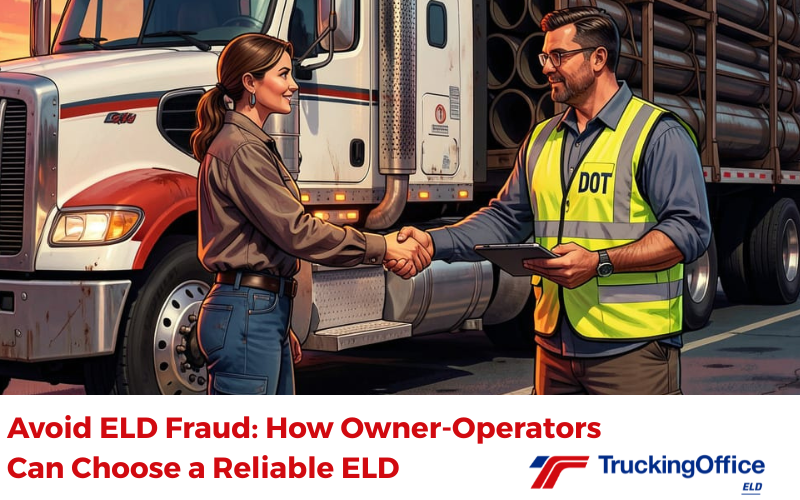
The bots on social media platforms have been slamming anyone who expressed a mild interest in trucking with posts about truckers being pulled from the roads because they can’t read a children’s book and an increasing number of reports about ELD frauds.
Contract terms deserve the same scrutiny as the device itself — here is what to look for in a no contract ELD before you sign anything.
Before you shop, read our cheap ELD buying guide for owner-operators to see why no-contract pricing matters more than the sticker price.
If your current device has been removed from the FMCSA list, here is what to look for when you need a new ELD.
ELD fraud is the deliberate falsification or evasion of electronic hours-of-service records. It happens two ways: drivers and carriers tamper with a device to bypass federal HOS limits, or ELD vendors sell equipment that does not meet FMCSA requirements and rebrand it to stay on the approved ELD list. For an owner-operator, the practical risk is buying a device that later gets removed from the FMCSA register — which leaves you out of compliance at a roadside inspection.
ELD tampering was the driver focus of the 2026 Roadcheck — here is what inspectors look for and how to prepare your rig.
(Or is it just me? I didn’t think so.)
And sometimes, those two topics appear to be linked. Bad trucking companies are hiring untrained, illiterate drivers and then using multiple methods to bypass the government-mandated hours-of-service (HOS) limitations.
What Is the ELD Mandate?
The ELD mandate is the FMCSA rule that requires most commercial drivers to record their hours of service electronically instead of on paper. Before the electronic logging device (ELD) mandate went into effect in 2017, truckers had the option of using paper logs. A trucker would carry a notebook that tracked driving hours by hand. Paper logs were easy to edit and unreliable in dishonest truckers’ hands. The restrictions on driving times were (and remain) constraints on responsible truckers who could drive more hours safely, but the introduction of ELDs was designed to stop truckers from lying about their HOS.
It didn’t take long for truckers and trucking companies to find ways around the ELD tracking systems. The ELD mandate went into effect in December, 2017. In 2018, we saw reports of ELD fraud.
Many truckers claimed that the HOS restrictions were too great. Shippers wanted their deliveries faster. More time on the road meant more profit for the truckers and the logistics companies. But they weren’t the only ones who were cheating the system
ELD Self-Certification: How Bad Devices Got Approved
When the ELD mandate was first announced. the process for ELD companies to get their product on the FMCSA approved list was self-certification. The companies submitted documentation to the government, but the government didn’t test the ELDs. Over time, some ELDs have been removed from the list.
TruckingOffice was once contacted by the DOT for a problem with our ELD and we responded immediately with a plan to solve it. That’s how the system works.
Of course, some companies found a less ethical way around the problems with their products. Instead of fixing the problems, they simply rebrand and get back on the approved ELD list again. If that isn’t ELD fraud, we don’t know what is.
How ELD Fraud Costs Honest Owner-Operators
We believe the majority of independent owner-operator truckers are honest and honorable people. They may not like the HOS restrictions and hate the ELD, but they comply with the rules. They just want to run their businesses and an ELD is required.
That’s why ELD companies that rebrand non-working equipment, it costs money when an honest trucker buys a bad ELD. They’re throwing hard-earned money away.
New FMCSA ELD Certification Rules
In 2025, FMCSA has announced new certification processes to limit ELD fraud. Technology has changed in the last eight years. The new regulations address those updates.
- Upgrades to 4G or 5G
- Better data transfer to make roadside inspections easier
- Enhanced security protocols.
The new standards will improve truckers’ experience with the ELD. The job of the independent owner-operator is to research the options on the registered ELD list of approved equipment. Choosing a product that’s been on the list from the very beginning like TruckingOffice ELD can help a trucker know they’re not buying bad equipment. Having a reputation for quality and consistent customer service is a good sign that this ELD is a safe investment.
Using a delisted ELD can lead to problems. On the road inspectors might find an ELD that’s been removed from the register – and that means that the trucker is out of compliance. They could put the truck out of service. Fines and penalties? Log violations? HOS citations? Is it worth it? Nope! It’s smart to get a compliant device onboard before the deadline.
How to Choose a Reliable ELD as an Owner-Operator
To choose a reliable ELD, verify the device on the FMCSA registered ELD list, then pick an established brand that provides ongoing support and software updates. Technology and current standards from the government are changing. Checking the ELD registry to verify equipment is a simple task a trucker could do while waiting for a shipping crew to finish their work. Using an established brand with support and updates for their E-Log device helps protect an independent trucker from wasting money. Good equipment helps drivers stay on the road, not have to worry about compliance at an inspection, and have confidence in the produced reports.
If you’re looking for a reliable, compliant, easy to install and easy to use ELD, consider TruckingOffice ELD.
ELD Fraud FAQs
What is ELD fraud?
ELD fraud is the deliberate falsification or evasion of electronic hours-of-service records. Drivers and carriers commit it by tampering with a device to bypass federal HOS limits. ELD vendors commit it by selling equipment that does not meet FMCSA requirements and then rebranding it to get back onto the approved list instead of fixing the product.
How do I check whether my ELD is still FMCSA-approved?
Check the FMCSA registered ELD list at eld.fmcsa.dot.gov. Devices can be removed from the registry after they were originally approved, so an ELD that was compliant when you bought it may not be compliant today. Verifying your device takes only a few minutes and can be done from the cab while you wait on a shipping crew.
What happens if you are inspected with a delisted ELD?
If a roadside inspector finds an ELD that has been removed from the FMCSA register, you are out of compliance. That exposes you to log violations and hours-of-service citations, on top of the money you already spent on a device that no longer counts.
Why did unreliable ELDs get on the FMCSA approved list?
When the ELD mandate was first announced, manufacturers self-certified their own products. Companies submitted documentation to the government, but the government did not test the devices. Over time some of those ELDs were removed from the list.
What are the new FMCSA ELD certification rules?
In 2025 FMCSA announced new certification processes intended to limit ELD fraud, reflecting eight years of technology change. The updates cover upgrades to 4G or 5G connectivity, better data transfer to make roadside inspections easier, and enhanced security protocols.
“Werq” Kevin MacLeod (incompetech.com)
Licensed under Creative Commons: By Attribution 4.0 License
https://creativecommons.org/licenses/by/4.0/
Recent Comments