


Are you new to the trucking industry? Getting started as an independent driver or owner-operator can be a costly investment that requires you to be making money from the start. For most of us, goal setting is an ideal way to make sure you’re making a profit as soon as possible. Your new trucking company can’t wait. So how do you decide what those goals are?
Reached your first-year targets ahead of schedule? Read what to do when your trucking business goals are met before the year is out.
SMART Goals for a New Trucking Company
Trucking company goal setting is the process of deciding what your new business must achieve with cash flow, equipment maintenance and customers, then tracking your progress against those targets so you are profitable as soon as possible.
If you look up “goal setting” online, you’ll see SMART goals.
- Specific
- Measureable
- Achieveable
- Results focused
- Timely
But what if you don’t know what your new trucking company can do? What if you don’t know what you should do?
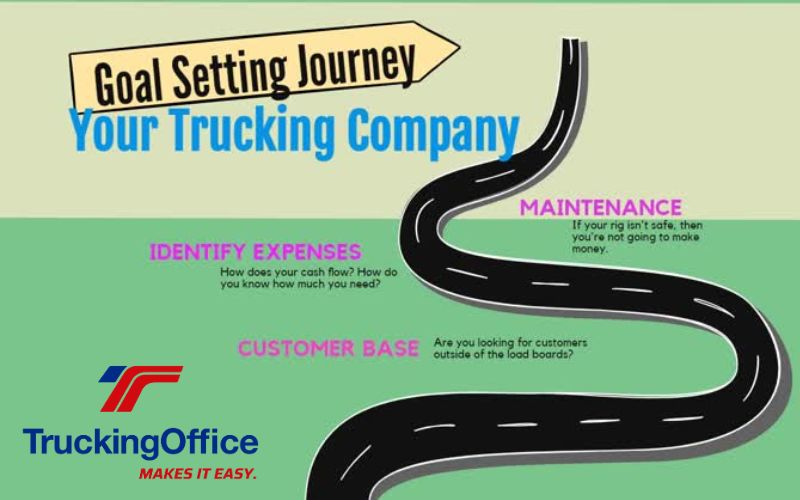
Let’s break it down into three categories that your new trucking company must consider.
Cash Flow – Money in, Money Out
We’ve heard of the odd trucker or two who were able to buy their first trucks with cash. That’s probably not the norm. Buying a used truck is considerably less than the over $100,000 a new cab costs (and that doesn’t include the trailer.) On top of that, there are plenty of other expenses to get started, like insurance, bonds, living expenses, mortgage and equipment loan repayments, software and ELD… the list goes on and on.
The weird thing about the trucking industry is that it pays by the mile, not by time. So trying to figure out a semiannual payment like insurance or a monthly payment (like the loan to buy equipment) is complicated. How do you compute a payment to you by miles when the bills come in monthly?
Start with your expenses
Collect all of your stable expenses into a spreadsheet. Business expenses and living expenses – because we are NOT hauling freight for fun. We have to make money on loads. Add it all up and start with that number. Then come the operating expenses for a business. Software like TruckingOffice PRO and equipment like TruckingOffice ELD pay for themselves by managing your business and keeping your rig compliant. Add their annual costs (TruckingOffice ELD doesn’t require a contract, so multiply the monthly cost by 12).
Then remember to pay yourself!
How much do you and your family need you to bring home every month?
Add those numbers up and you have a base that you NEED to make. But you’re not profitable yet. Taxes. Don’t forget you’re going to pay taxes – income, business, IFTA and IRP – just to start. Then there’s the Social Security and other withholding fees you’ll pay as a self-employed independent driver. (Some states even charge a property tax every year on vehicles you own. If I lived in a state that did that, I’d be moving out pretty fast, right?
Now, if you wanted to convert that to miles, divide that total by the average dollar amount per mile you see on the load boards. Don’t use the top dollar amount. Nobody always gets the top-dollar loads.
Don’t get discouraged. You’ve already done more work than most new trucker do. And this sets you up for success.
Equipment Maintenance
Just like we have to take care of our homes, we have to take care of our homes on the road. That means regular maintenance and preventative maintenance, because the costs of an on-the-road repair can wipe out a month’s worth of income. In an informal survey of truckers, keeping their rigs in shape was their highest concern. If you bought a used rig, then making sure that everything is in its best possible condition is vital.
Maintaining equipment isn’t cheap. But it’s stupid not to keep your rig in good running order. Annual Road Checks can put you off the road until you can prove your rig is safe to be on the road – and that’s time and miles you’re missing the opportunity to earn.
(Just a reminder – the International Roadcheck is scheduled for May 13 — 15, 2025 in the U.S., Mexico, and Canada.)
If you’re running short every month, it can be tempting to pass on preventative maintenance on your rig. It will be a lot smarter to find where you’re losing money and close that gap rather than skipping maintenance.
At the same time you’re hauling loads with your current equipment, it’s wise to look ahead. Keeping an emergency fund of $10,000 (we used to say $5,000, but inflation) to cover an on-the-road tow and repair isn’t unreasonable. It’s smart to be prepared. Building up that emergency fund might take a long time, but it’s important!
Building a Customer Base
Load boards are one way to find loads. But building a relationship with a company to haul regular loads is golden. Golden your pocket. If a local company doesn’t have to factor in the cost of going through a broker or a load board to get their goods hauled, that’s more money for you.
Developing a relationship with a local company can be as simple as getting to know your neighbors. Or joining the local business network like the Chamber of Commerce. When you can get to know the people who are shipping, you can get the first dibs on those lanes and a relationship that can last for years.
What’s all this got to do with goal setting?
Goal setting for a new trucking company means turning those three areas into written targets: one financial goal, one maintenance goal and one customer development goal that you can measure every month.
Looking at the forest and the trees, consider your goals from each of those perspectives.
Financial goals:
Set a goal that will cover 110% of your monthly expenses for your new trucking company. OK, dream big. 150% of your monthly expenses and get started on those emergency savings plans. This means you’ve looked at what you’re capable of handling. It may mean passing on something that looks like easy money, but deadheading the trip home might ruin the profitability of the trip.
Maintenance goals:
Set a goal that keeps you on the road. Get that preventative maintenance scheduled with a maintenance tech you trust. (TruckingOffice PRO can help you do that!) Save up that $10K emergency fund. Do the daily inspections to make sure your rig is in the best condition and if you see something that needs attention – do it!
Customer Development goals:
These may be the hardest, but in the long haul, this is the way to go. Make the time and efforts to reach the companies near your home base so that you’re at home more.
Trucking Company Goal Setting FAQ
What are SMART goals for a trucking company?
SMART goals are goals that are Specific, Measurable, Achievable, Results focused and Timely. For a new trucking company, that means turning a vague aim like “make money” into concrete targets for cash flow, equipment maintenance and customer development that you can check every month.
How much revenue should a new trucking company aim for each month?
Set a goal that covers at least 110% of your monthly expenses, including business costs, living expenses, software and ELD, taxes and the pay you take home. A stretch goal of 150% of monthly expenses lets you start building emergency savings.
How big should an owner-operator’s emergency fund be?
Plan for an emergency fund of about $10,000 to cover an on-the-road tow and repair. The figure used to be $5,000, but inflation has pushed repair costs up. It may take a long time to build, but it keeps one breakdown from wiping out a month of income.
How do you turn monthly expenses into a per-mile target?
Add up all of your monthly business and living expenses, taxes and your own pay, then divide that total by the average dollar amount per mile you see on the load boards. Use the average, not the top rate, because nobody always gets the top-dollar loads.
How can a new trucking company build a steady customer base?
Build direct relationships with local shippers who need regular loads hauled. Getting to know your neighbors or joining a local business network like the Chamber of Commerce can earn you first dibs on lanes, and shippers who skip a broker or load board leave more money for you.
Not sure about those financial goals? Then you need TruckingOffice PRO.
TruckingOffice PRO and TruckingOffice ELD
Using an integrated system allows an independent owner operator to have the same benefits that big trucking companies have in expensive software solutions. TruckingOffice offers the best options for the solo trucker. We’ve got affordable trucking management software that handles everything. TruckingOffice PRO makes your life easier and managing your business smoother by helping you handle your tasks better and faster:
- automatic rate con imports
- dispatches
- routing
- invoices
- expense management
- IFTA and IRP
- maintenance
- Trucker Stats™– reports to show the state of your trucking business.
Combined with the TruckingOffice ELD, you’ve got everything you need to build a successful trucking business – even from the cab of your truck.
Contact us today to learn how TruckingOffice PRO can help you build your trucking fleet!
Recent Comments