


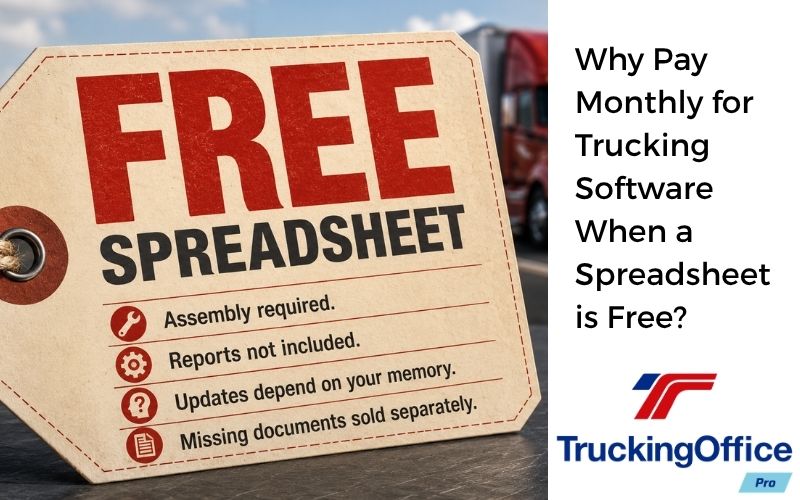
Particularly when starting a new trucking business, every penny needs to pay for itself – twice. Smart truckers will look at every expense to determine its value to a new trucking company.
Trucking software in particular gets that kind of scrutiny. And it should. Depending on the fleet size and the feature package, trucking software can range from less than a dollar a day to thousands per year for an enterprise system.
So why pay for a monthly subscription when a spreadsheet is free?
Do Spreadsheets Work for Trucking Companies?
Spreadsheets can work for trucking companies. They’re good at storing information, performing calculations, and creating customized reports. They also seem far less expensive, especially with Google Sheets. Free spreadsheets allow you to create files to track all your data.
| Load Management | Business Management | Equipment Management |
| Rate cons | IFTA and IRP payments | Repair records |
| Dispatch details | Office expenses | Equipment warranties |
| Documents (BOL, POD) | Fuel Purchases (with proper receipts for IFTA) | Maintenance schedules |
| Expense records | Invoice processing, including past-dues and detention fees. | DVIRs |
Spreadsheets can store records in these categories, no problem. But where do you store the miles per state needed for IFTA and IRP? Are those under Business Management or Equipment Management? Since fuel receipts and payments are under Business Management, but IFTA requires both miles per state and fuel receipts.
And compliance requirements? Do you place driver records, medical cards, CDLs, and drug/alcohol testing records under Equipment Management? (That sounds a bit insulting.)
Or do you split them up and force CDL under Equipment Management, but the rest under Business Management? What about load permits or temporary fuel permits? Are those in Load Management, Business Management, or Equipment Management?
How do you track customers, vendors, brokers, and your kid who washes your truck every Saturday? Ok, the kid is easy. The vendor who handled your roadside breakdown in Indiana… what was his name, and do you have a warranty on the work he did on your fuel pump?
How To Track Invoices with a Spreadsheet
Invoice management looks like the simplest part of any spreadsheet system. The rate con can be linked to a cell. The load is given an identification number for your system, and programming can combine everything with that code into an invoice packet.
Here’s one problem: How do you track invoices over time?
If you create a new worksheet for every month, how do you handle payments that are 30 days later – 1 or even 2 months after the load is delivered? Are December’s deliveries in last year’s file or this year’s?
Here’s another problem: How do you track past-due invoices?
If the invoice you’re looking for was from a load in late January but wasn’t sent until February, and is still unpaid in April, which file do you check? The January load file, the February invoice file, or the April accounts-receivable file? If the files are organized by month, one invoice now belongs to three different timelines.
Spreadsheets organize data – but what happens when the data defies organization?
Who Supports Customized Spreadsheets?
When you create your own spreadsheets, who do you call for support?
Who Supports Your Homemade Spreadsheet System?
| Problem | Your Support Department |
| A formula stops working | You |
| Linked files stop updating | You with coffee |
| The IFTA total looks impossible | You with stronger coffee |
| Your bookkeeper can’t understand the system | You, explaining why “FINAL-3” is not the final file |
| You’re sick or on the road | Ghostbusters? |
Your spreadsheet system may work for you. But you’re working for the system, not using the system to build your business.
Are There Hidden Costs to Spreadsheets?
Hidden costs show up when the system is not as interconnected as it needs to be and problems arise that can cost the truck owner money.
| Hidden cost | How a TMS can help |
| Invoice sent days late | Create and send the invoice soon after delivery |
| Missing POD or rate confirmation | Keep documents with the load record |
| Unpaid invoice overlooked | Show open and overdue invoices |
| Duplicate data entry | Reuse load, mileage, fuel, and expense information |
| Lost receipt | Store a digital image with the trip or expense |
| Time spent finding records | Search by load, customer, vehicle, date, or invoice |
| Spreadsheet error | Use trucking-specific workflows and reports |
Is Trucking Software a Better Tool Than Spreadsheets?
Complete trucking software is a better tool because it saves you time. The programming work is already done.
The value of a TMS comes down to two things: the time it saves and the money it helps you avoid losing. Take IFTA, for example. There are some preprogrammed spreadsheets available on Etsy or other websites. One question: who updates the quarterly tax rates? There are free and almost free websites that can compute your cost per mile or IFTA taxes. But do you know what they do with the data that you enter into their “free calculator”? Some websites will let you enter all your data for free, but then charge you for the report.
Check for the Free Trial Most TMS for small fleets or owner-operators give you a free trial. For example, TruckingOffice gives you a free 30-day trial for the entire platform to try everything from rate con upload to Trucker Stats™ – the business analysis reports. Other companies offer shorter trials or block access to the full program. Make sure the program has what you need before you sign a contract.
How Does TMS Save an Owner-Operator Money?
As an owner-operator, failure to send out complete invoice packets, not having the right documents, or missing an IFTA deadline costs money – more than a monthly subscription to trucking software costs.
It looks like you’re saving money if you’re using a spreadsheet system to run your trucking business. Instead, you’ve got a tangle of linked formulas and a crisis that you may not be able to solve while you’re on the road.
That’s going to cost you money. A spreadsheet may be free to use, but the system built on it takes time to develop and is not risk-free to maintain.
- Reentering data – possibly multiple times.
- Searching for documents is time-consuming when you could be with your family or on the road.
- Repairing broken formulas and bad links.
- Retaining required records (IFTA for 4 years, most tax records for 3 years for the IRS)
- Updating tax rates.
A complete trucking management software system brings those records and workflows into a single trucking-specific system.
TruckingOffice PRO and TruckingOffice ELD move data from smartphones to handle all these tasks without extra data entry. It blocks the opportunity for mistakes to creep in. Instead of spending hours at a desk—or, worse, scrolling through maintenance records on a smartphone while waiting for roadside service – trucking software frees you to do what you wanted in the first place: to be a trucker.
FAQs
Can an owner-operator run a trucking business with spreadsheets?
Yes, it can be done. However, when a trucker creates a customized set of spreadsheets, it may be difficult for another person to understand the files, formulas, and procedures without the owner-operator’s help.
Are spreadsheets really free for a trucking business?
The spreadsheets may be free. The time to create the complete system isn’t free, because it takes time off the road and time away from family and friends. However, building and maintaining the system requires:
- establishing the organizational system,
- creating spreadsheets and formulas,
- updating the structure or applicable tax rates,
- managing permissions,
- setting security protocols and maintaining backups.
This isn’t a one-and-done task. For a new owner-operator who might not know all the business and trucking regulations, this could be extremely complicated and stressful.
“Once the setup is done, I’ll just use these sheets forever” might be the mindset, but in reality, maintaining the spreadsheets will require time and coffee. A lot of coffee.
When should an owner-operator replace spreadsheets with a TMS?
Consider switching to complete trucking software when you want load management—dispatch, routing, document collection, and delivery—connected to expense management and invoicing. Some trucking software packages only serve as load management tools that stop at delivery. They may not include invoicing, compliance, or maintenance management.
Complete trucking business software doesn’t manage just the loads.
A complete TMS creates and controls invoices (including past-due invoices), tracks maintenance records and schedules, and allows access to authorized users.
Is trucking management software better than spreadsheets?
Trucking management software is designed to work immediately from account setup. Customized spreadsheets take time, expertise, and testing to build before they are used to manage a trucking company’s accounts and data. Beyond just load management, trucking management software also helps organize the business expenses and other payments, such as loan repayments, rent, subscriptions, insurance payments, and paying yourself.
For compliance, trucking software keeps data organized and easy to access for audits or inspections. Spreadsheets can be an adequate choice at first.
TruckingOffice customers often report that the software pays for itself. Getting one forgotten invoice out of limbo can cover a lot of monthly subscriptions. Preventing them from taking the trip there in the first place is even better.
Can a TMS eliminate all manual data entry?
Not yet. But with AI, manual data entry is certainly decreasing through uploaded images, imported documents, and ELD data transmitted directly. Voice input already exists – just ask Alexa.
However, whether the data is scanned, uploaded, or spoken, it’s still the trucker’s responsibility to check its accuracy.
Do You Need Spreadsheets or Trucking Software?
A free spreadsheet looks like the winning choice against a monthly subscription to trucking software, but when you look behind the screen, costs and concerns need to be addressed.
The right question isn’t “Which program costs less?” The right question is, “Which system gives me more time to haul freight, manage my business, and make a profit?”
TruckingOffice’s no-risk free trial will provide you with the experience you need to make the right decision for your trucking company.


Trackbacks/Pingbacks