


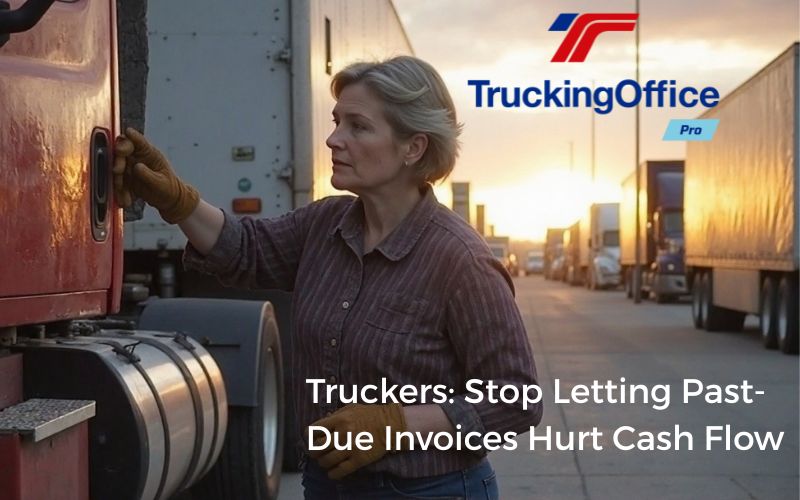
It sneaks up on an owner operator with no warning. Business is good. And then the truck owner realizes that there isn’t any money to pay for fuel. What happened? Everything looked good – on paper. But past-due invoices haven’t been paid, and the bank accounts are low. When unpaid freight invoice tracking is ignored, cash flow suffers.
Unpaid invoices still count as income on your trucking profit and loss statement under accrual accounting, which is why a profitable month on paper can still leave you short on cash.
Detention charges are one of the easiest line items to lose. See how an ELD documents detention time so those fees make it onto the invoice instead of getting written off.
Past-due invoices show up as the gap between revenue billed and revenue paid — two numbers every trucker should watch on their monthly reports.
Unpaid Freight Invoice Tracking
Unpaid freight invoice tracking is the practice of following every invoice you send to a broker or shipper until the payment lands in your account. It is how an owner-operator catches a late payment while there is still time to act on it, instead of discovering the shortfall at the fuel pump.
Our in-house trucker, Allen Campbell, has a story about his trucking company. Regular lanes from a local business to another state open up opportunities to bring home some freight instead of deadheading. His business was doing well, hauling freight around the eastern half of the US. The regular lanes produced steady income. So why wasn’t there money to pay for fuel?
The problem was simple, once he took a look at his spreadsheets. He wasn’t being paid for those other trips that sometimes took the drivers far from his home base. Why not? Why weren’t the invoices being paid?
And better – why didn’t he notice that he wasn’t being paid?
Freight Factoring: A Costly Fix for Late Payments
Freight factoring is the practice of selling invoices to a finance company for a portion of the invoice’s value, in exchange for cash right away. Allen’s cash flow problems led him to freight factoring. The cash he got from selling the invoices covered the cost of the fuel. But he wasn’t making as much profit on the loads. This became a pattern that Allen wanted to stop.
The key wasn’t factoring. The key was tracking those past-due invoices. In the early 2000s, Allen ran his trucking business on multiple spreadsheets. Invoice tracking isn’t very spreadsheet-friendly, and often delays were due to a lack of necessary documentation. By the time his bookkeeper noticed the late invoice, the records may have been shoved into a box in a closet a month ago.
TruckingOffice Trucking Management Software
With the development of TruckingOffice, a cutting-edge trucking company software package, tracking invoices became far easier. By emailing the invoices and sending images of BOLs, payments sped up. Problems were identified faster and solved quickly. Unpaid freight invoice tracking became a simple daily task instead of a weekly slog through the back of the closet. As the entire transportation industry – and the rest of the world – moved to using electronic systems, freight invoice tracking reduced the need for factoring.
Or did it?
Trucking software has taken over the industry. Creating an invoice has been simplified to the push of a few buttons. So why are so many independent truckers struggling with cash flow?
Why Trucking Cash Flow Stalls
Cash flow in a trucking business is the difference between the money that actually arrives from paid invoices and the money going out for fuel, maintenance, insurance, and truck payments. A carrier can look profitable on paper and still run short of cash when invoices sit unpaid for weeks.
In 2021 and 2022, the trucking industry saw record pay-per-mile rates. Between the supply chain breakdowns from the pandemic and international freight delays, rates skyrocketed. Some owner operator truckers wouldn’t move out of their recliners for less than $3.00 per mile.
Those high-paying loads also saw record prices for diesel fuel. The inflation rates of the early 2020s ate up those “big profits.” Truckers were facing a net loss in their businesses. Thousands of trucking companies – not just the independent small fleets, but big ones like Yellow Freight – closed.
Truckers who depend on spreadsheets or accounting software that isn’t trucking-specific may have trouble getting paid. Brokers and shippers may cut costs on truckers’ backs and delay their payments for 60 to 90 days. The result? Cash flow is stalled.
TruckingOffice PRO solves many of the problems that independent truckers, owner operators, and small fleet managers face with its complete invoice management process.
How TruckingOffice PRO Tracks Past-Due Invoices
Getting those unpaid invoices with TruckingOffice PRO starts with the invoices tab on the menu. Under that tab, you’ll find a number of reports that focus on unpaid invoices. At 30 days, another invoice can be sent – or it can be a reminder to contact the shipper about the invoice. Are they missing critical documents? Why is the payment being delayed?
Complete billable accessory charges are added to the invoice easily to reduce the “we don’t have the BOL” complaints that some shippers might use. With TruckingOffice PRO, BOLs and other documents can be stored and sent with the invoices.
Because TruckingOffice PRO is accessible wherever a trucker has an internet connection, invoices can be sent while the truck driver is still in the yard. It isn’t a matter of waiting until the driver gets home with all the documents. Uploaded images, immediate access to extra charges, and a signed BOL can be sent to the broker or shipper within minutes of the delivery. No more waiting to send the invoice speeds up the payments.
Pay attention to past-due invoices. Even when business looks good, unpaid invoices hurt good trucking businesses. Keep your business on the road and profitable by checking invoices regularly and contacting the shipper or broker when they’re late.
Frequently Asked Questions About Past-Due Freight Invoices
What is unpaid freight invoice tracking?
Unpaid freight invoice tracking is the practice of following every invoice you send to a broker or shipper until the payment actually lands in your account. It lets an owner-operator catch a late payment while there is still time to act, instead of discovering the shortfall at the fuel pump.
What is freight factoring, and does it fix trucking cash flow?
Freight factoring is the practice of selling invoices to a finance company for a portion of the invoice’s value in exchange for cash right away. It can cover an immediate bill like fuel, but you keep less profit on the load. Tracking past-due invoices so they get paid in full is the more durable fix.
How long do brokers and shippers take to pay a trucking invoice?
Brokers and shippers may cut costs on truckers’ backs and delay payment for 60 to 90 days. When payment terms stretch that far and invoices are not tracked, cash flow stalls even though the business looks profitable on paper.
What should a trucker do when a freight invoice is 30 days past due?
At 30 days, send the invoice again or use it as a reminder to contact the shipper directly. Ask whether documents are missing and why the payment is being delayed — those two questions resolve most late freight invoices.
How does TruckingOffice PRO help with past-due invoices?
TruckingOffice PRO puts unpaid-invoice reports under the invoices tab, so overdue invoices are visible in one place. Billable accessory charges are added easily, BOLs and other documents can be stored and sent with the invoice, and invoices can go out from the yard within minutes of delivery instead of waiting for the driver to get home.
Professional Requests vs. Demands: What Works for You?
Is resending the invoice an effective way to get unpaid freight invoices paid? Do you prefer calling instead of email? Do you keep track of companies that haven’t paid in a reasonable amount of time – and avoid them in the future? Do you think that brokers help you – or stall you – to get that cash into your pocket?
Let us know what works for you!

Recent Comments