


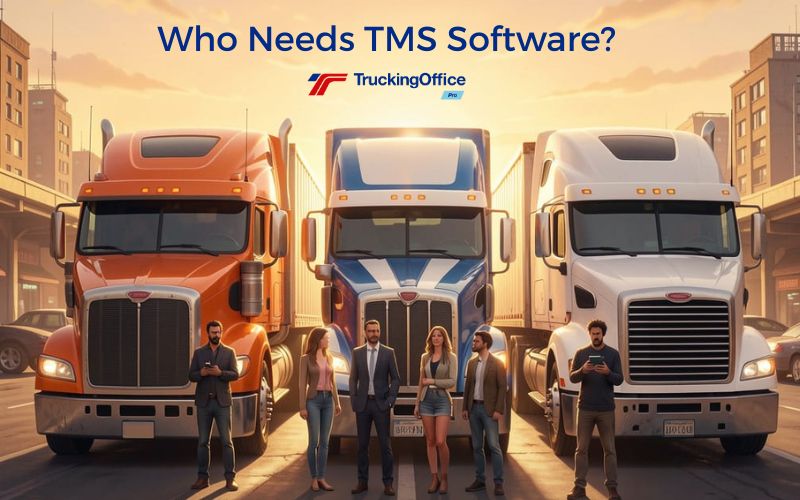
TMS stands for Trucking Management Software. Large transportation companies, small fleet companies, and owner-operators all need software to run their businesses to manage dispatches, routings, invoices, and maintenance compliance.
So a simple answer to “who needs TMS software?” could be “anyone who drives a truck.” But there’s a lot more to it.
Trucking management software might be as important as a vehicle to a trucking company.
What Does TMS Software Do in Trucking?
Trucking management software allows a trucking company to plan, manage and optimize daily shipping operations. A trucker or the support staff use it for
- Dispatch management – dispatch loads and create routings
- Expense tracking – collect the expenses to add to the invoice
- Manage invoicing – send out invoices, track payments and past-due invoices,
- Maintenance compliance – maintain DOT-required maintenance records and schedule future services
- Tax reporting – prepare tax reports for IFTA and IRP
- Business analytics – provide deep analysis tools for the state of the business finances.
Trucking companies need all of these options. Their complex operations need a computer to track everything as the government increases its requirements.
How TMS Helps Different Trucking Companies
Every size trucking company benefits from using TMS.
| User Type | How TMS Helps | Key Advantages |
|---|---|---|
| Large Transportation Companies | Centralizes dispatch, multi‑driver coordination, compliance oversight, maintenance scheduling, and financial analytics across many trucks and terminals. | Operational efficiency at scale, reduced administrative labor, unified reporting, stronger compliance controls, improved profitability visibility. |
| Small Fleets | Manages dispatches, invoices, driver settlements, maintenance reminders, IFTA/IRP reporting, and customer communication. | Keeps the office organized, prevents missed invoices, supports growth without adding staff, improves cash flow, simplifies compliance. |
| Owner-Operators | Tracks loads, miles, fuel, expenses, invoices, maintenance, and tax reporting in one place. | Saves time, reduces paperwork stress, ensures accurate IFTA, improves profitability tracking, keeps the business compliant with minimal effort. |
Does an independent trucker or owner-operator need that much?
Yes. Even one‑truck owner‑operators need TMS because they still handle dispatching, invoicing, compliance, maintenance, and tax reporting. TMS keeps their business organized, compliant, and profitable without relying on multiple spreadsheets or manual paperwork.
Everyone in the industry, whether self-employed or signed on to a major carrier, needs the back-office support to handle invoices, compliance, and taxes. Whether it’s the trucker, someone back home handling the paperwork, or a small fleet manager, it is necessary to have someone handling the paperwork. They must
- Find loads on load boards or developing customer relationships.
- Invoice management to keep the cash flowing.
- Keep records for compliance.
So small owner-operator trucking businesses need TMS, too.
Why should owner-operators use TMS when spreadsheets are free?
Plenty of owner-operators, working with tight budgets, look at TMS prices and can’t justify the expense. Using an Excel spreadsheet or even a Google Sheet seems like a better option.
The drawbacks to using spreadsheets look pretty weak. The same information is being tracked. Does it matter if the information is in a spreadsheet or TMS?
Three reasons why TMS is a better deal than spreadsheets
Things to consider when choosing between a spreadsheet and TMS.
- Spreadsheets scatter information
When a trucker has a spreadsheet for every piece of information that they track, it’s impossible to track the impacts.
For example, Expenses.
Controlling expenses to reduce cost per mile is the most important thing a trucker can do to increase profitability. But if the expenses are spread over multiple spreadsheets
- tax deductible expenses
- fuel purchases
- non-tax deductible expenses
- maintenance records
for example, it would be almost impossible to see where expenses can be cut.
TMS keeps all of the data in one place so all expenses are entered the same way. When a trucker wants to know their CPM, the program collects all data from all the necessary databases and calculates it in seconds.
- Spreadsheets require manual programming
For example, IFTA and IRP
Those formulas don’t just appear on a spreadsheet. Someone has to take the time to create the formulas, test them, and then update the tax rates as needed. Every quarter, the programmer must go to the IFTA website and check them.
The miles per state records for IFTA and IRP are the same except for the time period. IFTA is filed quarterly, IRP is filed semi-annually. So while the data is in there, it will take extra steps to extract it for the six-month period.
- Spreadsheets don’t scale
For example, buying another rig.
If a trucking company maintains five spreadsheets per vehicle, that means doubling the number of spreadsheets when a trucker expands their business with a new rig. While a trucker sees that as no extra out-of-pocket expense, it increases the computer time for updates for taxes and attempts to study the business as a whole, not per truck.
Time, Money, and TMS
TMS saves time, reduces paperwork, improves cash flow, and keeps trucking businesses compliant — benefits spreadsheets can’t match.
For an owner-operator who is handling all the paperwork and back-office tasks, time is a huge factor. The hours off the road are hours not earning money. Entering data in multiple spreadsheets is not efficient. For the small fleet manager, spreadsheets limit the flexibility they need to make dispatch decisions. For large trucking companies – they recognized very early the value of having a centralized system to reduce overhead and dispatch issues.
That’s how TMS came into existence. Big companies developed the software. Little companies saw the value and wanted the same benefits. But owner-operators too often looked at the cost and wrote it off. The price was simply too high.
But trucking software didn’t need to be hosted on an expensive server for owner-operators or small fleet managers. And it doesn’t have to be costly. In fact, many companies find that using a TMS like TruckingOffice PRO cuts down the time spent handling the back-office tasks and speeds up data entry with automatic rate con and expense uploads.
TruckingOffice PRO
TruckingOffice PRO automates dispatching, invoicing, IFTA reporting, maintenance tracking, and business analytics so truckers spend less time on paperwork and more time earning money on the road.
With TruckingOffice PRO, you’ll get error-free reports and avoid fines or penalties. Companies also enjoy the freedom that comes from less time spent on paperwork. Imagine no more tedious checking and rechecking math or worrying about audits! All that free time can be spent on the road, growing your business.
When you decided to become a trucker, you didn’t plan on spending so much time being an accountant. You don’t want to be behind a desk, you want to be behind the wheel. That’s why you’ll love our TruckingOffice PRO software.
You can try it for free! Sign up now for the free 30-day trial of the entire program.

Updated June, 2026.


Recent Comments