


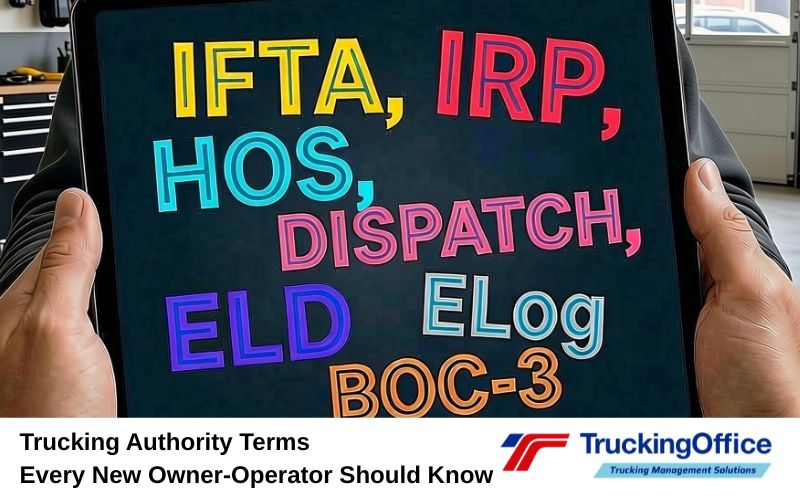
Starting your own trucking company means learning a new language. From FMCSA filings to IFTA and IRP, you’ll encounter dozens of unfamiliar terms while applying for your trucking authority. This glossary explains the most important terms in the order you’ll typically encounter them.
Once the terminology makes sense, look at how owner-operators expand a trucking revenue stream by becoming a freight broker.
Running under someone else’s authority has its own vocabulary. If you are weighing that route, see whether a new owner-operator should lease on with a trucking company.
Thinking about running under someone else’s authority instead? To Lease On or Not? Part 2 breaks down what a carrier keeps for its cut, why we don’t recommend lease purchase, and the questions to ask before signing.
Not sure how the MC number fits with the rest of these terms? Start with our guide to what an MC number is and how to get one, then use this glossary as your reference.
Start Here: The 10 most important trucking authority terms.
Step 1: Business Setup
Every trucking company begins with a business. Before you can apply for operating authority, you’ll need to decide how your business will be organized and obtain the identifiers needed to operate legally.
Sole Proprietor
A sole proprietor is a person who owns an unincorporated business by themselves. Income is filed on Form 1040.
Business Plan
A business plan is a document in which you lay out the current status of your business and your plans for the future. Learn more from TruckingOffice’s series of posts on the process.
LLC
An LLC is a Limited Liability Company, a business structure set up by states for companies. Cost is determined by the state.
EIN
An EIN, or Employer Identification Number, is an identification number issued to businesses by the IRS. There is no charge. Apply online.
Now that your business is established, the next step is registering it with the federal government.
Step 2: Licensing and Registration
Once your business is established, it’s time to register it with the appropriate government agencies. These are the terms you’ll see throughout the trucking authority application process.
DOT
DOT stands for Department of Transportation. It may refer to the US Department of Transportation (USDOT) or a state’s Department of Transportation. (ODOT – Ohio Department of Transportation)
FMCSA
The FMCSA is the Federal Motor Carrier Safety Administration, tasked by the DOT to manage safety concerns in the trucking industry, its primary mission is to prevent commercial motor vehicle-related fatalities and injuries.
USDOT Number
A USDOT Number is a unique identifier for commercial vehicle operators in interstate or intrastate commerce. Most interstate commercial vehicles with a GVWR, GCWR, actual weight, or combined weight of 10,001 pounds or more require it.
GVW, GVWR
Gross Vehicle Weight – The actual weight of the truck alone.
Gross Vehicle Weight Rating (often used interchangeably) is the maximum weight a vehicle is rated by the manufacturer to handle, including passengers and any luggage. This refers to the truck alone, not the trailer or the payload.
GCWR
Gross Combined Weight Rating is the maximum total weight of the truck + trailer + cargo.
MC Number
An MC Number is the identity number of your trucking business license, issued by the US Government. The MC Number (Motor Carrier Number) identifies a for-hire motor carrier operating under FMCSA operating authority. Although FMCSA has begun transitioning to newer registration systems, many truckers still use the term “MC Number.”
Operating Authority
Operating authority is a business license from the FMCSA granting permission to a motor carrier to transport regulated freight for hire in interstate commerce.
Trucking Authority
Trucking authority is a common industry term for FMCSA operating authority.
MCS 150
The MCS-150 is the Motor Carrier Identification Report used to notify FMCSA of changes to the company record or to complete the biennial update.
Once your registration is complete, you’ll need to file several additional documents before your authority becomes active.
Step 3: Required Filings
After receiving your business identifiers, you’ll need to complete several required filings before your operating authority becomes active.
Insurance
Insurance is purchased to provide financial protection or reimbursement against losses resulting from accidents, injury, or property damage.
| Type | Description |
| BIPD Insurance (also called Primary Liability) | Bodily Injury and Property Damage insurance covering to protect against claims for injuries or property damage caused while driving a vehicle. |
| Cargo Insurance | Insurance to cover cargo during transportation. It covers the shipper’s investment. |
| Physical Damage Insurance | Insurance to cover damage to the trailer due to accidents, theft, or disasters. It covers the carrier’s vehicle and trailer. |
BOC-3
A BOC-3 is a required FMCSA filing that designates process agents in every state where a motor carrier operates.
Process Agent
A process agent is your representative that may receive court documents for your business when you live in a different state.
UCR (Unified Carrier Registration)
UCR (Unified Carrier Registration) is an annual registration program that requires many interstate motor carriers to pay fees based on fleet size.
Motus
Motus is the new FMCSA platform to serve as a truck company’s contact with USDOT. New truckers use it to apply for USDOT number, operating authority, and other requirements.
With those filings in place, you’re ready to learn about the state registration and fuel tax programs that apply to interstate trucking.
Step 4: State and Fuel Tax Programs
With your authority in place, you’ll also need to meet state registration and fuel tax requirements before operating across state lines.
IRP
The International Registration Plan is a method for consolidating truck registrations with one agency, allowing trucking companies to pay state fees in two filings per year. It eliminates the need for truckers to register in every state or province. IRP allocates and distributes the collected fees based on miles driven over the past 6 months. Truckers are given a cab card and an apportioned license plate to travel through member states/jurisdictions.
| IRP Categories | Descriptions |
| IRP Registration | Purchasing the apportioned plates from the state through their board of motor vehicles. Cost is determined by a variety of factors. |
| IRP Apportioned Plates | License plates for cabs that indicate an IRP registration. |
| Temporary Trip Permit | A short-term permit that allows a commercial vehicle without IRP registration to operate legally in a specific jurisdiction for a limited time. It is not the same as a Temporary Fuel Permit. |
Learn more about IRP and the filing at TruckingOffice’s IRP site.
KY Number
A KY Number, or KYU, is a tax license issued for all carriers traveling on Kentucky roadways with a combined license weight greater than 59,999 pounds.
IFTA
IFTA, the International Fuel Tax Agreement, is a method for paying quarterly fuel taxes once, rather than filing with every jurisdiction your truck passes through. Truck owners have to file quarterly, and failure to do so has severe consequences.
| Term | Description |
| IFTA License | Permission to carry goods across state/province borders. |
| IFTA Decal | An adhesive label for trucks registered with IFTA. |
| IFTA Sticker | The more common name for an IFTA decal. |
| IFTA Audit | An assessment of a trucking company’s IFTA records. |
You can learn more about IFTA, IFTA filings, and IFTA reports from TruckingOffice’s IFTA Resource Center.
After meeting registration and tax requirements, your focus shifts to staying compliant while operating your business.
Step 5: Compliance and Safety
CDL
A CDL is a Commercial Driver’s License, issued by states. Most states require drivers to pass a truck-driving school exam to get this license. Depending on the license and endorsements sought, applicants may also be subject to federal Entry-Level Driver Training requirements.
Electronic Logging Device (ELD) (ELog)
An electronic logging device – often abbreviated to ELD or called an ELog – is a device that tracks a truck’s activities to monitor the driver’s hours of service (HOS). Over time, its capabilities have expanded to GPS tracking, IFTA miles per state tracking, and other uses. You can learn more about ELDs from TruckingOffice’s ELD page.
HOS
HOS is the abbreviation for Hours of Service. Federal HOS rules limit when and how long many commercial drivers may drive and work and establish requirements for breaks and off-duty periods. The rules have been adapted for a variety of circumstances. Consult the FMCSA site for clarity on the rules.
New Entrant Safety Audit
The New Entrant Safety Audit is an examination to approve a permanent DOT number. When a new trucking company gets its DOT number, it starts an 18-month probationary period where safety and compliance are monitored by the DOT.
Authority Reinstatement
Authority reinstatement — required after an authority is revoked for any reason — is the process by which the DOT reactivates the DOT number. The cause of the revocation and the fines and penalties must be paid for the reinstatement to be effected.
Revocation
Revocation is when the DOT retracts the DOT number, thereby eliminating the trucking company’s ability to transport loads. Reasons might include failure to handle DOT paperwork correctly or on time, driver incapacity, or vehicle condition.
Step 6: Operating Your Business
Dispatch
Dispatch can mean either the act of sending a truck to pick up a load or the entire process of moving the freight. Dispatchers may communicate with drivers, brokers, shippers, and receivers to help keep loads moving.
Factoring
Factoring is a financial agreement between a trucking company and a finance organization to sell the invoice at a discounted amount before it is paid. See how freight factoring works for truckers.
Trucking Management Software (TMS)
Trucking management software is a program for managing a trucking company’s operations. It usually includes dispatching and invoicing. It may include maintenance compliance, driver management, statistical analysis of the business finances, and offer integrations with other devices (such as ELD) or software programs. TruckingOffice PRO is an example of a complete TMS.
Finally, let’s look at some of the tools and services that help owner-operators run a successful trucking company.
Step 7: Business Structure and Operating Models
Owner-Operator
An owner-operator is a truck driver or small-business owner who owns or leases the truck they operate. An owner-operator may operate under their own authority or lease on to another motor carrier.
Leased-On
Leased-on refers to a contract between an owner-operator and a transportation company in which the driver provides their own rig and equipment to haul freight. The contract lists the roles of both parties.
For-Hire Carrier
A for-hire carrier is a motor carrier that transports passengers or property for compensation. Depending on the operation, a for-hire carrier may need FMCSA operating authority in addition to a USDOT Number.
Private Carrier
A private carrier is a company that transports its own property as part of its primary business rather than transporting property for compensation as a for-hire carrier.
Commonly Confused Terms
| Term | Not the Same As |
|---|---|
| USDOT Number | MC Number |
| Trucking Authority | USDOT Number |
| GVWR | GVW |
| IRP | IFTA |
| Temporary Trip Permit | Temporary Fuel Permit |
| IFTA Decal | IRP Plate |
Frequently Asked Questions
What is the difference between an MC number and a USDOT number?
A USDOT number identifies your company for safety monitoring and is required for all interstate commercial carriers. An MC number is your operating authority — the license to haul regulated freight for hire across state lines. Most for-hire interstate carriers need both.
Do I need both an MC number and a USDOT number?
Most for-hire interstate carriers need both. The USDOT number registers your company with the FMCSA for safety tracking, while the MC number grants the authority to be paid for hauling freight. Carriers that haul only exempt commodities, or that operate only within one state, may not need an MC number.
What is the difference between IRP and IFTA?
IRP (International Registration Plan) covers truck registration: you buy apportioned plates and your registration fees are divided among the states where you run. IFTA (International Fuel Tax Agreement) covers fuel taxes: you file one quarterly fuel tax return instead of filing in every state. Interstate trucks over 26,000 pounds typically need both.
How much does it cost to get your trucking authority?
The FMCSA charges a one-time $300 filing fee for each operating authority. Beyond that, plan for a BOC-3 filing, UCR registration, apportioned plates through IRP, and insurance — by far the largest startup cost for a new authority. See our guide to estimating your authority startup costs.
How long does it take to get trucking authority?
Plan on roughly four to six weeks. After you apply, the FMCSA publishes your application and holds a 21-day protest period, and your insurance and BOC-3 filings must be on file before your authority becomes active.
Next Steps
Learn How to Get Your Trucking Authority
Choose Trucking Management Software
Recent Comments