


When a trucker has a dispatch and a route, they know where to deliver the load. The process is clear: pickup, transport, delivery. When you decided to start a trucking business, you chose to operate under your own authority.
Load decisions got more complicated when you sat down with the numbers – cost per mile, revenue per week, expenses per load. With experience and knowledge, you’re building a promising trucking business.
But growing a trucking business doesn’t come with turn-by-turn directions. You need to choose a destination, study the road behind you, and decide which loads will move the business forward.
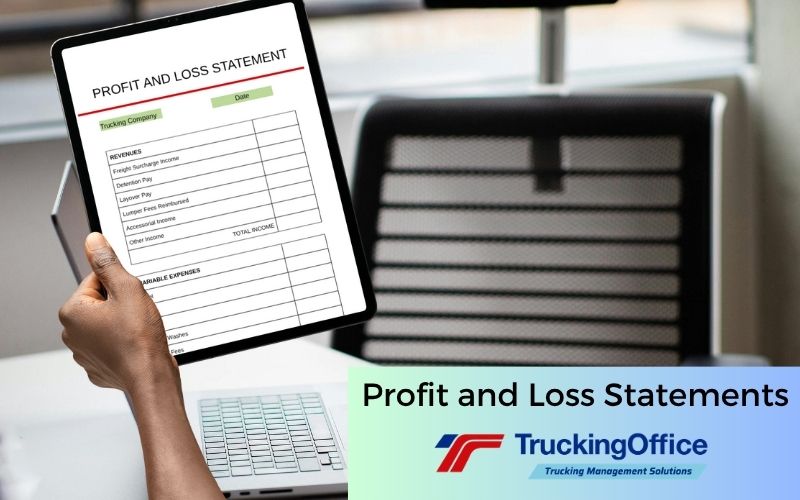
A profit and loss statement is one report that helps you chart that route. What is it? What does it show?
What is a Profit and Loss Statement?
A profit and loss statement (P&L) is an income statement for a business that outlines a company’s revenue, costs, and expenses over a specified period of time.
Source: Investopedia
Why Does a Trucker Need a P&L?
A trucker needs a P&L to show how the business has performed in the past. Think of it like the view in the rearview mirror: it shows whether the road you traveled last month, quarter, or year produced a profit.
The basic formula is Revenue (all income) – Expenses = Profit or Loss.
Understanding what the business earned, what it spent, and what remained gives you information you can use to make better decisions. That bottom line shows whether your decisions moved the business forward—or backed it into a loss.
Where Does Your Income Come From?
For truckers, the answer is obvious: you get paid to haul freight.
However, when you send an invoice packet, the rate con may also include accessorial pay. Detention pay, fuel surcharges, layover pay, and similar charges count as business income for the P&L and tax records.
Where Do Your Expenses Go?
This is a loaded question. A trucker must consider everything from fuel, maintenance, and compliance costs to the personal expenses that come with spending days or weeks away from home. Some belong on the business P&L and may be tax-deductible. Others are personal expenses, but they still affect how much the business must earn to support the owner.
What Time Period Should a P&L Cover?
Here’s the thing: it’s completely flexible. If you have a software program that produces P&L
statements on demand, you can produce one whenever you want. If you’re paying an accountant to prepare it, you’ll want to consider that expense. But here’s the value:
If you’re looking at the categories of income and expense over time, what’s going to show you where you’re making money?
Month-to-month comparisons can show longer trends, while shorter periods can help you examine particular loads or operating decisions.
Compare Two Weeks of P&L
Suppose you ran two different types of freight during two weeks: one cross-country load during the first week and multiple in-state loads during the second. A separate P&L for each week might reveal some surprising results.
Two Routes, Two Results*
*These are fictional numbers for illustration only.
| P&L category | Cross-country week | In-state week | What it reveals |
| Loads completed* | 1 | 6 | More loads do not automatically mean more profit |
| Loaded miles* | 2,700 | 1,500 | The cross-country load generated more miles |
| Deadhead miles* | 300 | 250 | Both weeks included unpaid miles |
| Load revenue | $7,200 | $6,600 | The cross-country week earned more freight revenue |
| Fuel surcharge and accessorial pay | $750 | $800 | Extra charges contributed meaningful revenue |
| Total revenue | $7,950 | $7,400 | The cross-country week brought in $550 more |
| Fuel | $1,600 | $1,020 | Distance made fuel considerably more expensive |
| Tolls | $260 | $60 | The cross-country route added highway costs |
| Scales, parking, lumpers, and other load expenses | $140 | $300 | Multiple local loads created more individual load expenses |
| Maintenance and repairs | $250 | $150 | Both weeks carried operating costs |
| Allocated weekly fixed costs | $1,200 | $1,200 | Insurance, depreciation or lease costs, software, and permits continue regardless of route |
| Total expenses | $3,450 | $2,730 | The cross-country week cost $720 more |
| Net profit | $4,500 | $4,670 | The in-state week produced $170 more profit |
| Profit margin | 56.6% | 63.1% | The in-state loads kept more of every revenue dollar |
*Loads and miles provide operating context. They do not ordinarily appear on a standard P&L.
The cross-country week generated $550 more revenue, but it also cost $720 more to operate. After expenses, the in-state week produced $170 more profit and kept a larger percentage of its revenue. The longest route brought in the most money, but it did not move the business furthest toward its profit goal.
How Can a Trucker Use a P&L to Grow?
How can a P&L show you how to grow your business?
- Compare similar periods. Compare weeks to weeks, not weeks to months. With a specified time limit, you compare apples to apples. In the same way, you want to consider the seasons. Comparing freight from a low-volume month like January to a high-volume June might help you might figure out when the best time to take vacation, but not what types of loads you want to make the largest profit.
- Identify increasing expenses. Fuel prices aside – because who can predict those? – but there are other expenses that can be monitored. It may be worth an investment in a slow cooker and a cab refrigerator to cut food costs – and calories. Watching increasing expenses in maintenance costs may indicate it’s time to consider new equipment.
- Historic expenses vs. current expenses. Comparing previous years with the current year may show trends in types of loads that are more – or less – profitable.
- Test your decisions. We’re not weathermen who make predictions using computer models. Knowing our numbers and having the experience of thousands or millions of miles under us can help us make educated guesses, but actual experience can’t be duplicated. And nothing is written in stone. If after years of long-distance cross country trucking, you decide to try regional for a time and hate it, you can go back. You’re the boss.
Use the Road Behind You to Choose the Road Ahead
A P&L is not going to tell you which load to take. It shows you what decisions you made and what you’ve done in the past. It’s up to you to discover the patterns and trends which impact your business. That tells you if you’re moving in the right direction.
Profit and Loss Statement FAQs for Truckers
What is a trucking profit and loss statement?
A trucking profit and loss statement is a financial report that shows a trucking company’s income and expenses over a set period and whether the business ended that period with a profit or a loss. It examines one moment in time in a trucking business to determine the state of the company’s finances. Banks and investors treat it as the key component showing a trucking business’s financial health.
What is the difference between accrual and cash accounting for truckers?
Accrual accounting counts income when a load is invoiced, so a load hauled and billed in November belongs to November even if the payment lands in December. Cash accounting, which many independent owner-operators use, is based on actual cash movement: money received in November belongs to November, and a bill received in November but paid in December belongs to December.
Are unpaid invoices included in a profit and loss statement?
Yes. Profit and loss statements also include unpaid invoices. A load hauled in November and billed before the end of the month is included in the November P&L statement even if the customer does not pay until December.
Do banks and investors require a profit and loss statement?
Investors and banks expect to see a profit and loss statement. It is the key component used to show the financial state of a business, which makes it essential when a trucking company is seeking a loan or outside investment in order to expand.
What does a profit and loss statement not show?
A profit and loss statement does not break performance down by trip, truck, or time period, so it will not tell an owner-operator whether long-distance trips beat local lanes. Revenue reports such as Trucker Stats™ and the Company Overview Report in TruckingOffice PRO use the dispatch and invoicing data already in the system to provide that level of detail.



Recent Comments