


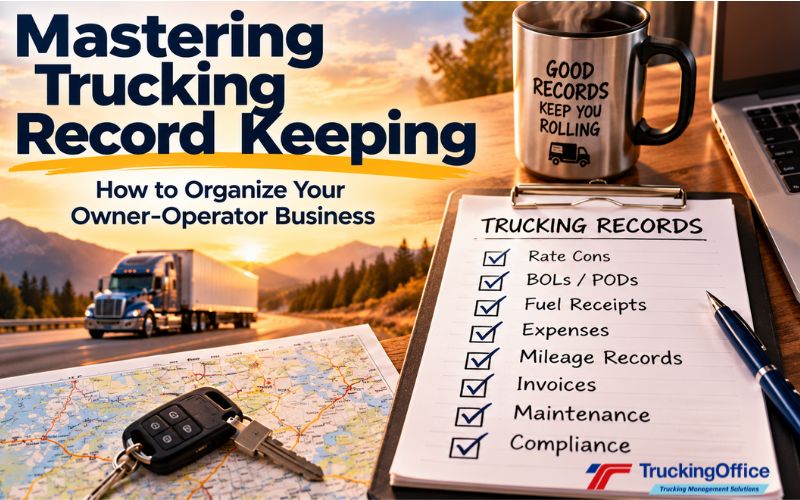
Every single day, your trucking company creates records. Not personal records like your personal best deadlift of a truck tire. Too bad – an Olympic truck tire lift would be fun to watch – but other records.
- Expense receipts
- Miles per state
- Fuel purchases
- Accessorial charges
- BOLs/PODs
- Rate cons
- Loads and income.
How Organized Are You? Take the Quiz

Owner-Operator Record-Keeping Quiz
1. It’s IFTA time. Where are your fuel receipts?
- A. Filed by quarter and ready to go.
- B. Some are in the truck. Some are at home. One may have gone through the washing machine.
- C. I have a shoebox. Technically, that’s a filing system.
2. A broker asks for the signed POD from a load you hauled two months ago. What happens next?
- A. I pull it up in about 30 seconds.
- B. I search my phone, email, glove box, and that folder called “TRUCK STUFF.”
- C. I tell the broker, “Define signed.”
3. An IFTA auditor asks you to support the mileage and fuel numbers on your return. You say:
- A. “Sure. Here are my records.”
- B. “How do you feel about screenshots?”
- C. “Before we begin, I should probably explain what happened to my old phone.”
Scoring
- Mostly A: Look at you. Your paperwork may actually be as organized as you claim.
- Mostly B: You have records. Finding them is apparently a separate business operation.
- Mostly C: TruckingOffice PRO would like a word with you… before an auditor does.
What Records Should an Owner-Operator Keep Organized?
Do you need to keep coffee receipts? (No.) Do you need to keep fuel receipts? (Yes.) That’s a bit unfair that fuel for your truck is more important than the fuel that keeps you on the road, but that’s the government for you. No, I don’t want my coffee taxed more, either.
Here’s a list of records that you should keep and why.
| Record | Why You Need It |
| Fuel purchase records | IFTA and business expenses |
| Mileage records | IFTA and IRP |
| Rate confirmations (rate cons) | Load terms and invoicing |
| BOLs/PODs | Proof of delivery and invoice packets |
| Expense receipts | Bookkeeping and taxes |
| Invoices | Accounts receivable and income records |
| Maintenance records | Maintenance management and DOT compliance |
| IFTA returns and supporting documentation | IFTA reports and audits |
| IRP records | Registration and apportioned mileage support |
| Driver and vehicle compliance records | DOT compliance |
Keeping the records is only half of the job. Finding them when you need them is the other half. And the other half is keeping the right records for as long as you need them.
Yeah, that’s three halves. It’s a big job, running a trucking company.
How Long Should Owner-Operators Keep Records?
There is no standard for all trucking company records. The IRS says some should be kept for 3 years, others for 4 years, 6 years, 7 years, or eternally, depending on the type of business and the specific records.
Purchases, sales, payroll, and other transactions you have in your business generate supporting documents. These documents contain information you need to record in your books.
But trucking companies also have industry-specific records to keep.
- Fuel purchase receipts have to include specific data for quarterly IFTA filings.
- Miles per state records are used for IFTA and IRP filings.
- Maintenance and repair records – annual inspection records, roadside inspection reports, and records showing that required repairs were made – need to be kept.
Not exactly what the average business needs to maintain.
How Long Do Owner-Operators Need to Keep IFTA Records?
Keep the mileage and fuel records that support your IFTA returns for 4 years. Even if the trucking company closes, keep the records legible and available. Digital receipts and records from an ELD or electronic truck log are acceptable as long as they are readable.
Why keep them? Because an IFTA audit may require you to produce the records supporting returns filed years earlier.
Keeping them organized and accessible isn’t the only organizational task of an independent trucker.
Maintaining Loads and Income Records
Every load needs a complete collection of documentation.
- ✅Rate con
- ✅Dispatch
- ✅Routing/mileage records
- ✅Expense records/receipts
- ✅BOL and POD
- ✅Invoice
- ✅Payment record
When this chain of records gets snarled like the interstates in Columbus, Ohio, it makes your trucking business records overly complicated. That makes it harder when it comes to billing, tax preparation, and paying yourself.
Because most general accounting software packages handle income and expenses, you might expect it to handle trucking invoices without a problem. And many of them do. But somebody still has to make sure the rate con, BOL/POD, receipts, accessorials, and other load information get from dispatch into the right places.
But using trucking management software (TMS) to organize your records makes going from rate con to dispatch to delivery to billing to payment far smoother. Instead of a collection of spreadsheets, a complete trucking management system doesn’t require you to re-enter data (and inadvertently introduce errors) and uses the same data for IFTA, IRP, invoice production and tracking, maintenance management, and business analysis.
Is Tracking Expenses the Toughest Part of Organization?
It’s certainly one of the most important. That’s why we highly discourage the use of your passenger seat as a filing system.
Plenty of truckers forget to bill for reimbursable expenses covered by the rate con and lose out on money they should have been paid.
TruckingOffice PRO is a better system than your passenger seat. It lets you upload expense records and attach them directly to the load for billing. It’s a lot less likely to fall into a puddle. And you can organize those records while you’re on the road instead of waiting until you get home.
Instead of sticking with the old envelope-and-spreadsheet system of the 1990s, you can organize your trucking business and keep all the details in one place. With TruckingOffice PRO, the same information can be used for dispatch, billing, IFTA and IRP, expense tracking, maintenance, and business reports.
TruckingOffice PRO has a free trial offer waiting for you right now – no contracts, no debit or credit cards needed, no trading in your grandma’s 2011 Corolla. Discover how organized your trucking company can be.
Getting organized can look like Mt. Everest from the bottom. It looks a lot smaller when your paperwork isn’t scattered across the passenger seat.

Updated October 2026

Recent Comments