


Many truck drivers start their careers by working for a corporate trucking company. For them, loads were assigned with the back-office paperwork managed. They clenched their teeth when dispatchers give impossible instructions. Saved money for the whole time until they could afford their own rigs, The day they become an owner operator, they were ready to take on the world through a load app. The highest paying loads were all long distance, cross-country trips. Regional trucking options didn’t look profitable.
Regional Trucking vs. Long Distance Trucking
After time driving freight on long-distance (OTR) loads, some truckers stick with what they know. But experienced owner operators might have a different perspective.
Long Distance Trucking
There’s no doubt that the industry needs long-distance truckers. Loads arrive at docks around the country and the freight has to move. We’re not saying that it’s bad for an owner operator to take on those loads. On the outside, it looks good.
- More loads are available on load boards.
- Rates are often higher for long distance loads.
- No extra downtime waiting for a crew to load or unload the trailer.
- Highway miles vs. driving through cities – reducing the last mile delivery time.
For many new truckers, the allure of the road and the variety of destinations make OTR loads look attractive. The challenges of moving freight across mountains and into deserts or the plains is appealing. When there’s no one at home that the driver is missing, OTR trucking is a great opportunity to make money as a trucker.
Regional Trucking
Regional truckers have benefits that OTR truckers may not see. It’s all about the numbers.
- Hours on the road vs. hours at home.
- Steadier income from known customers and regular lanes.
- Choosing to avoid the loads and routes that put hard miles on the equipment.
A new owner operator may not be thinking along those lines yet. They’ve never had to consider how long they would be on the road because they didn’t really have a choice. But once they’re working for their own companies, the attractions of running a regional trucking company will show up – once they see the numbers.
OTR truckers have to find a load home to make the trip profitable. A regional trucker could make the trip out and home in one day, making the deadhead miles less of a loss. By limiting which states a trucker chooses to drive through, the IFTA and IRP taxes may be lower (and certainly easier to file!) Regional truckers know the roads, the best stops for coffee and fuel, and can count on knowing the weather (and the detours.)
The Numbers You Need to Know
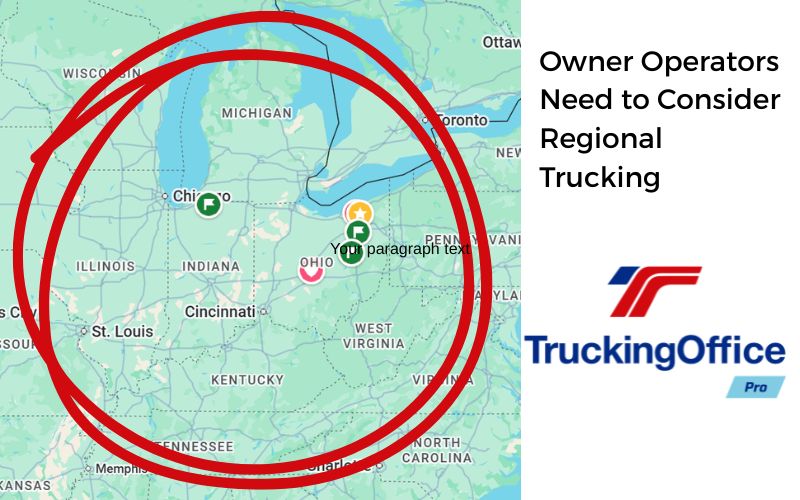
By limiting the loads to a region, a trucker might find that the profit from those loads is the greatest when the trips are between 200 and 500 miles.
How can that be?
Regular lanes are predictable. Building a relationship with a customer for consistent loads means a better experience for both trucker and shipper. Steady work means a trucker can plan when they need to leave and when they’ll get home. The company’s payment schedule is understood, and invoice payouts can be expected in a timely fashion.
Another important thing to consider is living expenses on a trip. Cross-country trips will require more food purchases, more coffee, and a stop or two somewhere to get a shower and wash clothing. Those expenses add up. Since they’re not tax-deductible (except the per diem pay), most truckers don’t track those expenses. But they still come out of the trucker’s pocket.
Knowing the profit per load is a critical number to understand. A cross-country load may pay higher per mile, but if the shipper has a slow pay process, that trucker’s invoice may be unpaid for months.
Cost Per Mile and Revenue Per Mile are almost opposites. How much does it cost to drive a loaded truck one mile? The number may be an average of the miles over several trips, but this is the single most important number a trucker needs to know. Unless the owner operator knows the cost per mile, they can’t make good decisions about taking a load from a broker or a load board. The Revenue Per Mile number must be higher than the cost per mile, or the trucker is taking a loss on the trip.
Fixed costs are not based on mileage. Insurance, office costs such as trucking software or ELD, loan payments – all of these are regular payments based per month, not per mile. Then there are the variable expenses, such as fuel, lumpers, and tolls. Those expenses are per trip, not per mile.
So how do you figure out cost per mile and revenue per mile?
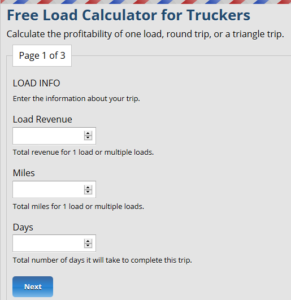
Math. Lots of math. That’s why trucking software like TruckingOffice PRO is so valuable to the independent owner-operator trucker.
TruckingOffice PRO will take all your numbers – expenses, income, and taxes – and compute your cost per mile and revenue per mile. In seconds, a report will show how a trucking company is doing financially. While not a Profit and Loss statement (which TruckingOffice PRO can compute), the company overview report can help an owner operator examine where the company can improve their cash flow.
How does all of this apply to regional trucking?
Regional trucking is consistently the most profitable type of trucking business. It’s not just about the comforts of being home consistently. It’s mathematically the most profitable type of trucking business. Taking shorter, regional loads
- reduces the living costs on the road
- keeps a trucker closer to maintenance techs that know their equipment
- produces regular income with more loads to invoice
- allows the trucker to know the shippers and the roads.
This is the sweet spot of freight hauling. New owner-operators may take some time to recognize it, but long-time truckers know what’s what. New owner-operators who know their numbers and analyze what is making money for their trucking companies may find that regional trucking businesses offer the best return for their time and effort.

Recent Comments