


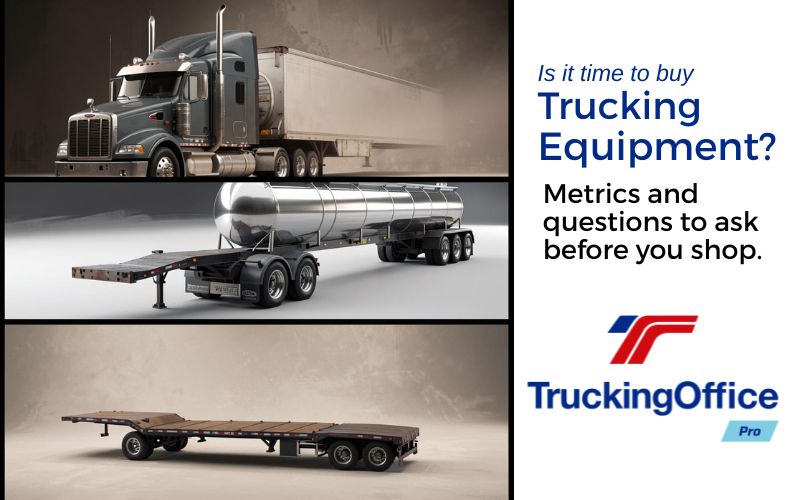
Is it wrong to think about growing your trucking business right now? There are always people willing to take risks even when the economic signs look questionable. This contrary mindset might be the start of growing an independent owner-operator trucking business into a fleet by purchasing trucking equipment.
Getting Started
Do you remember that excitement when you stepped up into your first cab? There aren’t many thrills like the moment when you see your dreams become reality. Going from a truck driver for another company to owning your own equipment is the first step to growing your trucking business.
Spending a year or two working for a transportation company will give anyone a good look inside the logistics industry – on their dollar. Long-time drivers often recommend getting training and certifications early. They say it’s easier to take the tests when the information you learned in driving school is still fresh in your mind.
Then you can decide if that first cab is an International or a Peterbilt. Or if you want a flatbed or a reefer. Talking to other truckers is never a bad idea, but your own experiences will tell you far more.
Buying a new truck isn’t an easy decision. Our resident truck driver, Allen Campbell, always recommends buying used trucking equipment when you’re starting out. The lower investment when starting out reduces the stress of the big monthly loan payment. A new owner-operator doesn’t need to be in a new truck – they need to be in a position to make the break into the market with the least amount of stress.
Taking Stock with Trucker Stats™
There’s a point when an independent trucker looks at the business and says
I want to grow.
But is it the right time?
The best way to determine if your company is ready to expand isn’t just a feeling. There are some metrics that might help make that decision.
Let’s take a look at four metrics to help clarify the decision.
Cost per Mile (CPM)
How much does it cost to move your truck?
If there’s one number a trucker must know, it’s the cost per mile. Knowing this number prevents the trucker from taking loads at a loss.
This isn’t a stable number, however, because it includes fuel. But the more expenses that get added to the number, the more reliable it is. So tracking all expenses, including the expenses that may not be applicable to a load, but are still part of a trucking business. Insurance that’s paid twice a year? It’s hard to compute a “per mile” when it’s a bill paid every six months.
(That’s why TruckingOffice PRO’s Trucker Stats™ is so valuable. The formula to create the cost per mile is preprogrammed and ready at the touch of a button on the screen.)
With the cost-per-mile number in hand, many load decisions are simple.
Revenue per Mile (RPM)
If the cost per mile is a study of how much it costs to move a truck per mile, the revenue per mile number is the opposite. How much is coming in from hauling loads?
The complication of this number is deadhead miles. The number can’t be calculated simply by using the miles per load. All miles count – deadhead, detours, dinners, and delivery.
The formula is simple – total revenue divided by total miles. That’s not so hard. But why is it valuable?
This number measures earning efficiency. “Earning” is easy – it’s the money gained by working. It’s “efficiency” that’s confusing. According to ChatGPT,
Earning efficiency is a measure of how effectively a business turns its available time, assets, or capacity into revenue.
In simple terms:
👉 It tells you how much money you make compared to how much opportunity you had to make money.
So Revenue per Mile shows how much money was made compared to how much effort was used to earn it.
How does that apply to buying new trucking equipment?
If the trucker wasn’t working full-time, then there is potential for earning more. The question then becomes “Will more trucking equipment make me more or less profitable?”
When the revenue per mile is stable or rising AND beats the cost per mile, expansion may be a good idea.
Gross & Net Profit Margins
Gross Profit Margins and Net Profit Margins aren’t opposites.
Gross Profit Margin is the revenue (income) earned, minus the direct expenses such as fuel, factoring, and fees.
Net Profit Margin takes the Gross Margin and subtracts all of the expenses, not just the direct expenses. That means subtracting the business expenses such as debt, taxes, and maintenance.
Why are these numbers good metrics? It takes a good look at current profits and allows the trucker to assess how much profit new trucking equipment might generate.
Cash Flow & Working Capital
Understanding how much cash on hand an owner-operator needs to run the business varies from trucker to trucker. A trucking company owner needs to have enough cash to make the monthly payments, cover fuel purchases, pay insurance, and cover potential repairs or maintenance. At the same time, the owner-operator has to have enough in the bank to wait for last week’s loads to pay – in maybe 30 days. (Maybe more.)
This is the negative number in the calculation of buying new trucking equipment. If there isn’t enough cash flow and working capital, buying new equipment will add to the problems, not resolve them.
In the end, the decision to buy trucking equipment is complex. It depends on what equipment is being considered, how much money it will cost, and what the long term impact on the trucking business will be. It’s much different buying another trailer from buying a new rig.
Questions to Ask About Growing a Trucking Business
After reviewing metrics, an owner-operator should ask:
✔ Is there guaranteed freight to haul – or a plan to depend on the load boards?
✔ Will expansion increase profits, or will the new trucking equipment’s cost exceed the profits?
✔ Will cash flow support the expanded expenses?
✔ If talking about buying another rig, can the trucking company staff manage drivers, compliance, and dispatch?
This decision will take time, metrics, and desire to grow a trucking company. At this time, the trucking industry is going through many challenges and truckers are leaving the industry, so more equipment is on the market now. This might be the right time to grow – or it may not. Talking with a financial advisor is a key part of making a smart decision.
Recent Comments