


For independent truckers, the purpose of trucking management software (TMS) is to keep the business organized. The purpose of the electronic logging device (ELD) is to track hours of service (HOS) and stay compliant. Is there a reason to have integrated TMS and ELD?
Integration only pays off when the data flows one way. Here is how efficient trucking software eliminates duplicate data entry for an owner-operator.
A connected ELD and TMS also make it far easier to collect the detention pay you are owed, because the waiting time and the invoice live in the same system.
Replacing a revoked device? Here is how to choose when you need a new ELD.
Automatic per-state mileage also makes fuel tax season far easier. See our guide to IFTA report basics for filing deadlines, required records, and how to submit your quarterly return.
New to the terminology? Start with our plain-English explanation of what telematics is and how truckers can use the data an integrated system collects.
An integrated TMS and ELD is a trucking management software system and an electronic logging device that share one set of data. Instead of entering miles, hours, and load details twice, the integration moves that data automatically – cutting errors and saving time for independent truckers.
An integrated system also feeds the numbers you need to calculate your trucking cost per mile automatically.
New: the TruckingOffice PRO app now lets drivers send BOLs, receipts, and stop updates to the office straight from the cab.
We can think of three.
1 Accurate Records Save Time
With an integrated TMS and ELD, shared data reduces the major problems with data entry. Instead of retyping and reentering data across the programs, the integration handles that data transfer.
This saves time by
- Reducing errors that stop customers from paying bills
- tracking locations when detention pay is contested
- tracking miles per state for precise IFTA filings and IRP reports.
Data from the ELD is a critical component in a trucking business. Without those numbers, it’s not analysis, it’s a guess
- how profitable a trucking company is (profit and loss)
- how profitable a load is (cost per load)
- how to select the right loads (cost per mile.)
Trucking company data analysis isn’t for the weak of heart, but with a reliable TMS, an independent trucker can take the deep dive into their own company and find the secrets that may turn around a mediocre company to a successful one. Using TruckingOffice’s Trucker Stats™, that data analysis can take seconds, not hours, to complete.
If you want to save time, using an integrated TMS like TruckingOffice PRO and TruckingOffice ELD can simplify many of the tasks an owner-operator must manage.
2 ELD Compliance
Integrated TMS and ELD gives a long-distance trucker up to date information. At a DOT inspection, a compliant E-log is necessary, of course. But the integration with a TMS allows the data from the ELD quickly and efficiently. Tracking HOS per day and remaining hours per week isn’t just about compliance – it’s about planning.
Knowing what the remaining hours on your clock
- focuses on what loads fit that time frame
- determines which load is better for the driver: short turn-arounds or longer distance, but a long rest break on the road
- matches fuel purchases with miles per state for IFTA reports.
Having the most accurate miles-per-state data from an ELD is far better than a guess by a trucker who forgot to note it manually in a log.
Using the TruckingOffice ELD with TruckingOffice PRO will help an owner-operator stay compliant while planning loads with greater confidence. If you need help to keep your hours, miles, and reporting organized, integrated software is a tool that can change.
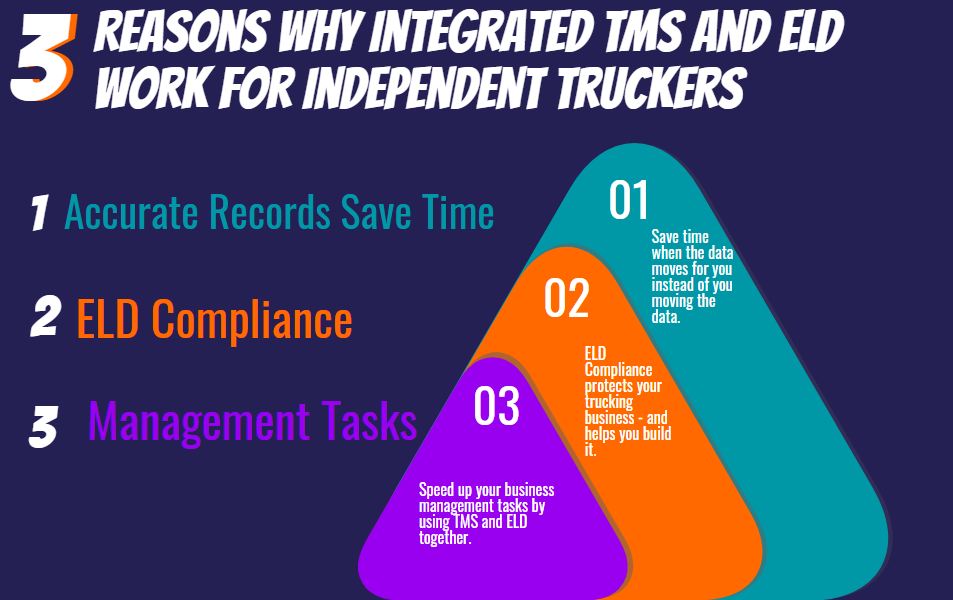
3 Integrated TMS and ELD Speeds Up Business Management
In the past, owner operators followed the lead of larger trucking companies and collected receipts and records in an envelope (or worse, a shoebox) to take home. Once they were back in front of their desktop computer, they’d sort out the receipts to be sure that all the receipts, the BOLs, and the mileage records matched before sending out an invoice. That reduced billing to a monthly task. The problems with this?
- Paperwork lost at the beginning of the month is probably gone for good.
- Mileage logs may be incorrect – a single switched number will take hours to track down.
- Past-due invoices extend further if payment is delayed due to missing documentation.
With an integrated TMS and ELD, those missing logs are automatically backed up by the ELD. The records are stored inside the TMS system, eliminating the need for paper receipts.
Why wait for the end of the month when the billing cycle can begin in your rig?
FAQ: Integrated TMS and ELD
What is an integrated TMS and ELD?
An integrated TMS and ELD is trucking management software and an electronic logging device that share one set of data. Instead of retyping miles, hours, and load details into two separate programs, the integration transfers the data automatically, which reduces the errors that stop customers from paying bills.
How does an integrated TMS and ELD help with IFTA reports?
The ELD records miles per state automatically, and the TMS matches those miles with fuel purchases for IFTA reports and IRP registration. That is far more accurate than relying on a manual logbook entry a trucker may forget to make.
Does an integrated TMS and ELD help at a DOT inspection?
Yes. A compliant E-log is necessary at a DOT inspection, and the integration keeps hours-of-service data up to date. Beyond compliance, knowing the remaining hours on your clock helps you choose loads that fit your available drive time.
Can an integrated TMS and ELD speed up invoicing?
Yes. Records like BOLs and mileage logs are stored inside the TMS and backed up by the ELD, so nothing waits in a shoebox of receipts. Billing can begin from the rig instead of waiting for a month-end paperwork session.
Is an integrated TMS and ELD worth the money for an owner-operator?
Customers find the time saved and the end of lost-record anxiety make integration worth it. TruckingOffice PRO with TruckingOffice ELD often costs less than buying a separate TMS or a different ELD alone, and a free trial is available.
TruckingOffice
TruckingOffice was one of the first TMS companies to integrate their ELD. Customers find that the time they saved and the elimination of the anxiety of lost records make the integrated TMS and ELD worth the money. Add to that the low costs of TruckingOffice PRO and ELD, and many truckers pay less than the cost of another TMS or a different ELD alone.
For the independent owner-operator, TruckingOffice is an option that’s worth consideration.
Contact us today for a free trial of TruckingOffice PRO and information on how to integrate TruckingOffice ELD.


Recent Comments