


Trucker Stats™ show truck owners and independent truckers the importance of analyzing their data. Two statistics – revenue billed and revenue paid – sound like they should be the same thing. Unfortunately, they aren’t. The attentive owner-operator can learn a lot from these two numbers on TruckingOffice PRO’s monthly Company Overview Report.
For a full breakdown of the monthly and trip expenses behind these numbers, read Trucker Success with Trucker Stats™.
Revenue billed and revenue paid both feed the bottom line on your trucking company profit and loss statement.
Revenue is only half the picture. To see what a single trip actually earned you, read Profit Per Load with Trucker Stats™.
Revenue only means something next to cost. Pair these numbers with your expenses per loaded mile to see what each load really earns.
Revenue tells half the story. The other half is what you spend, so learn how to manage trucking company expenses and track your true cost per mile.
Your revenue numbers feed a bigger document: what a trucking profit and loss statement shows about the health of your business over a whole month or quarter.
Billed revenue that never turns into paid revenue is a past-due invoice problem: here is how to stop past-due invoices from hurting your cash flow.
When those two numbers look healthy, the next question is whether the business can carry more: see how to decide if it is time to buy trucking equipment.
Shorter, predictable lanes also make payment timing easier to plan — see why owner operators need to consider regional trucking.
If you are tracking these numbers in a spreadsheet or an accounting program, read our comparison of trucking software and QuickBooks before your next quarter.
Revenue is only half the equation — compare it against your trucking cost per mile to know whether each load actually made money.
Want invoices out the door the day the load delivers? The new TruckingOffice PRO app lets drivers upload BOLs and receipts straight from the road.
Why is this important?
Understanding the difference between Revenue Billed and Revenue Paid helps trucking companies manage cash flow, monitor receivables, and make better financial decisions. Even owner-operators with a single truck need to know the differences and how they impact a trucking business.
Definitions
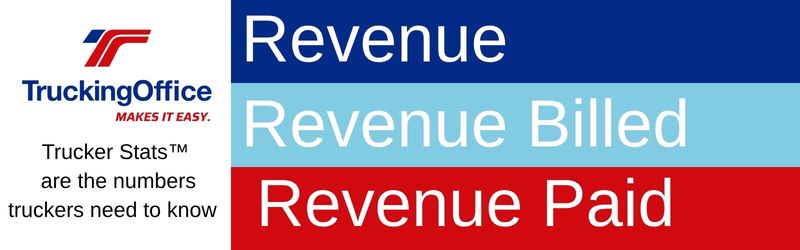
Revenue
Revenue always refers to the money the company earns regardless of payment status. In short, it’s income. It’s also referred to as gross income.
Revenue Billed
Revenue billed is the name for the money that has been invoiced. It’s the amount that the trucking company has sent an invoice to a shipper or broker. Accountants call this accounts receivable, or more casually, invoiced revenue.
Revenue Paid
Revenue paid is the money that has been paid by the shipper or broker to the trucking company. It is sometimes referred to as collected revenue. In accounting, revenue can be recognized before payment is received. Revenue Paid reflects actual cash collected.
All of these things sound the same. However, there are some key differences – primarily, where the money actually is right now. In standard accrual accounting, accounts receivable is considered to be income, even when the money hasn’t actually been paid. If the invoice hasn’t been paid, the receiver can’t spend it.
What is Cash Flow?
Cash flow is the movement of money in and out of a business over a specific period of time. This includes revenue and expenses. That’s why revenue isn’t a part of the formula. Cash flow is about cash, not invoices or unpaid work.
Let’s look at some numbers in an example.
| Month 1 | Amount |
| Revenue Earned | $20,000 |
| Revenue Billed | $20,000 |
| Revenue Paid (to the trucker) | $12,000 |
| Expenses Paid (by the trucker) | $10,000 |
The formula for cash flow is cash received – cash paid = cash flow.
Even with the earnings and the billing, it comes down to two numbers: Revenue Paid and Expenses Paid.
In this example, cash flow is $12,000 – $10,000 = $2,000.
If that $20,000 invoice isn’t paid promptly, then this trucking company may have serious problems with cash flow in the future.
That looks good for Month 1. But in Month 2, there are extra expenses, like quarterly IFTA and semiannual insurance payments.
| Month 2 | Amount |
| Revenue Earned | $20,000 |
| Revenue Billed | $20,000 |
| Revenue Paid (to the trucker) | $8,000 (the balance due from last month) |
| Expenses Paid (by the trucker) | $25,000 (IFTA payment due) |
Revenue Billed
Paperwork is never-ending in any business. It feels harder in trucking because everything else in the business is in the truck. That’s why a trucking management software that an owner-operator can use in the cab is so efficient. Waiting to get home and pull up a spreadsheet (or three) to complete an invoice hurts cash flow by delaying payments.
Sending a complete and accurate invoice has to be a top priority in the trucking company management. Sometimes, those expenses and numbers aren’t readily available, so the invoice is delayed.
It always comes down to organization with billing.
- Are the correct expenses entered?
- Is the BOL signed and attached to the invoice?
- Are the rate con details right?
Revenue billed – accounts receivable – must be accurate. When even one number is wrong, shippers stop payments. Staying organized is the only way to keep invoicing accurate.
Prompt billing protects cash flow.
Cash flow can only be positive when there’s money coming in.
Why wait for the end of the month to send bills? Many new independent truckers depend on bookkeepers and accountants to manage their business finances. It’s too important to pay the proper taxes and handle accounts payable and receivable. Even if they buy some reusable spreadsheets, it can be unnerving when facing the consequences for underpaying IFTA.
Will an accountant send out invoices directly after a freight delivery? Does a bookkeeper enter all the data during the shipping process so the invoice will be ready upon delivery?
When a driver uses trucking management software to enter receipts with cellphone pictures, an invoice can be sent quicker than waiting for the end of the month.
Billed Doesn’t Equal Paid: Past Due Invoices
A sent invoice doesn’t mean payment will arrive immediately. “Net 30” means full payment is expected in 30 days. Not all shippers or brokers pay on time. That’s why watching Revenue Paid on a Company Overview report is an indicator of potential future cash flow problems.
Making sure that all the data on the invoice is correct is the first step a trucking company should take. The next step is to monitor all payments to see what isn’t paid.
Some shippers will simply sit on the invoice if they have a problem until the trucker contacts them. It saves them money, right? Instead of waiting extra weeks until the end of the billing cycle, tracking payments that are over 30 days alerts the trucker. They need to pay attention to this invoice to make sure it gets paid.
Past Due Invoices Cost Money
It’s not just a cash flow problem. When an invoice is past due, that means someone must spend time tracking the problem and reaching out to the client. If the bookkeeper or accountant is making the calls, then it’s money out of the trucking company’s coffers. When it’s the driver who has to make the call, that’s time that could be hauling a load.
Why isn’t the invoice paid on time? There are as many reasons as there are invoices submitted. Every one requires a specific response. That’s a time suck no one wants.
Delayed payments can cause a cascade of problems from not having enough cash for a coffee to missing an IFTA payment.
Why Is Revenue Paid More Important Than Revenue Billed?
Here’s the monthly problem with cash flow. Most companies look at cash flow in a calendar month or four-week sections. So an invoice sent on Day 1 is unlikely to be paid before the end of the month or during the four weeks. If the terms are 30 days, the payment will arrive too late to show on the report.
So monthly reports won’t show the same Revenue Billed and Revenue Paid amounts.
Then why is the Revenue Paid a key number? Two reasons.
- Cash flow has to cover costs. If the cash isn’t in the bank, the company can’t pay its bills.
- The realized profitability of a load is calculated based on the money paid. An unpaid load costs money to ship – costing the trucker, not the shipper.
| Load | Revenue Billed | Revenue Paid | Expenses | Cost Per Mile | Profit per Mile |
| Load 1 – paid | $2,500.00 | $2,500.00 | $1,600.00 | $1.60 | $0.90 |
| Load 2 – unpaid | $2,500.00 | $0.00 | $1,600.00 | $1.60 | -$1.60 |
| Load 2 – finally paid | $2,500.00 | $2,500.00 | $2,000.00* | $1.60 | $0.50 |
*Increased expenses due to paying an accountant to rebill the shipper and track the late payment.
In this scenario, a past invoice drops the profit by nearly 50%. The same amount of pay but higher expenses means less money in the bank in the end. Unpaid invoices can lead to
- factoring loads to cover fuel purchases,
- credit card debt, and
- delayed or missed maintenance.
Common Mistakes with Revenue, Revenue Billed, and Revenue Paid
Unpaid invoices distort the financial reports.
The company looks profitable – on paper.
When an owner-operator confuses Revenue Billed with Revenue, it leads to financial confusion. Loads look profitable when they aren’t. Expenses can’t be covered when the money isn’t yet in the bank.
That’s why daily monitoring of past-due invoices is wise. Immediate reconciliation of the bank statements helps to be sure that the full payment is made. Too often, accessorial denials, refusals to pay detention fees, and short pays aren’t discovered until it’s too late.
Not using Revenue Paid to forecast cash flow
If an owner-operator used Revenue Billed to make financial plans, they may find their plans will fall through. The company’s budget may be based on incorrect information. For big-ticket maintenance projects, that could delay critical work or purchases, leading to failures of DOT inspections.
Failure to Track Profit per Load
Every trucking company exists to make a profit. Revenue looks like profit, but it lacks the critical other half of a company’s finances – expenses. Making decisions about loads with incomplete information leads to agreeing to loads that sound good but ultimately yield no profit.
Some companies have cut their costs on the backs of the trucking companies they hire. They slow-pay or never pay. Knowing which company or broker is a good client, and which isn’t sometimes takes experience (and maybe Reddit or another trucking forum), but it can prevent a trucker from repeating a mistake.
Taking the Right Road to Trucking Company Success
Understanding Revenue, Revenue Billed, and Revenue Paid can prevent many wrong turns in building a trucking company. Choosing a trucking management software over a general-purpose accounting program is the best decision a new trucking company owner can make. Understanding the differences and how they affect the bottom line is critical.
FAQ
Why isn’t Revenue Billed the same as Revenue Paid?
Primarily, it’s the location of the funds. If the money is invoiced, but not yet paid, it’s not in the trucker’s account and available to spend. Ideally, Revenue Billed and Revenue Paid happen together. They rarely do.
Can a trucking company be profitable but have poor cash flow?
Yes. Some trucking companies use factoring as a part of their business model to cover poor cash flow. Slow-pay, no-pay, and we’ll-get-around-to-it-pays don’t cover the costs of running a business with regular and costly expenses.
What causes Revenue Paid to lag behind Revenue Billed?
Most invoices are expected to be paid in 30 days. Most shippers take every one of those 30 days to pay. This is normal business practice. A trucker who keeps a large cushion to cover monthly expenses will be able to manage the cash flow of the payments coming in a month after the invoice is sent.
How often should owner-operators review these statistics?
When all invoices are current, checking the company bank statement and the TruckingOffice PRO Company Overview Account monthly is the minimum amount of review. However, once invoices are past due, contacting the shipper or broker and then watching for the payment might be better done on a weekly basis, if not more frequently. Getting to know the customers who don’t pay in a timely fashion will prevent a trucker from hauling for them again.
What is the difference between revenue and cash flow?
Revenue is the money a trucking company earns, regardless of payment status. Cash flow is the movement of money in and out of the business over a specific period of time — cash received minus cash paid equals cash flow. A trucking company can show strong revenue on paper and still run short of cash when invoices go unpaid.
Reconciling Revenue Billed and Revenue Paid
Since invoices are rarely paid in the same month as it’s sent to the shippers, the revenue billed and revenue paid numbers don’t balance right away. This is why truckers can use trucking management software to track these payments over time. A spreadsheet may have a notification coded in when a payment is late. But if that month’s spreadsheet is archived, that notification won’t alert the trucker to the problem. Using an accounting program that tracks invoices and expenses is the common practice.
But general accounting software programs can’t handle the specific needs of a trucking company. They should track late invoices and payments over time, but general accounting software doesn’t track miles per state or create IFTA reports. And if the bookkeeper or the accountant is handling all of the financial reporting, important knowledge that the trucker needs is not accessible
- Which brokers are hard to work with
- Which customers refuse to pay detention fees
- What routes aren’t profitable even if the rates are high.
That critical information can help a trucker decide which loads to take and what to decline.
Trucking Management Software Reconciles Invoices and Payments
Regardless of when an invoice is sent or when the payment is made, trucking management software tracks both. A trucker will know when an invoice is late, when it’s not fully paid, or when it’s paid in full.
That’s why trucking management software that handles all the back-office work is the best choice. Choose a program that
- handles dispatches and routings without extra data entry
- collects expenses, mileage, and applies them to the correct load
- creates a correct invoice and tracks payments
- manages vehicle maintenance records and schedules
- prepares accurate IFTA, IRP and other reports, such as the monthly Company Overview Report and a Profit and Loss statement.
- provides deep data analysis such as Trucker Stats™.
Finally, trucking management software must protect the company’s data but still make it accessible whenever and wherever it’s needed.
That’s TruckingOffice PRO in a nutshell.


Your point about the hidden cost of chasing down payments is spot on. If you’re burning hours on the phone tracking down a Net 30 that’s stretched to 60 days, that’s time you aren’t spending moving freight or growing the business. Plus, relying on generic accounting software instead of a trucking-specific TMS just sets you up to miss the fine details, like brokers who consistently dodge detention pay.